


In 2027, AI in marketing will move from writing help to doing the work: agents that build, launch and report on campaigns, AI search that answers before anyone clicks, and shoppers who arrive from AI assistants already knowing what they want. But many AI projects will also be cut, trust in AI handling personal data is low, and EU transparency rules now apply. The winners will use AI to go faster on narrow, well-defined jobs, keep people in charge of brand, prizes and data, and build an audience they own instead of relying on search traffic.
This is our view of the AI marketing trends that matter for brands and agencies in 2027, with sources for every number and practical steps at the end.
Where AI in marketing stands at the end of 2026
A few facts set the scene.
- AI search is everywhere. Google's AI Mode expanded in October 2025 to more than 200 countries and territories, including many across Europe.
- AI summaries reduce clicks. Pew Research Center found that users clicked a traditional search result in 8% of visits with an AI summary, against 15% without.
- AI sends better-prepared shoppers. Adobe measured that traffic from generative AI to US retail sites rose 769% year on year in November 2025, and that these visitors converted 31% better than other traffic over the holiday season.
- Consumers are trying it. Capgemini found that 25% of consumers used generative AI shopping tools in 2025, and a further 31% plan to.
Fewer visits, but better ones. That is the starting point for 2027.
7 AI marketing trends for 2027
1. From AI assistant to AI agent
In 2025 and 2026, most marketers used AI to write: subject lines, product texts, social posts. In 2027 the shift is to AI that acts. Gartner predicts that 60% of brands will use agentic AI for one-to-one interactions by 2028.
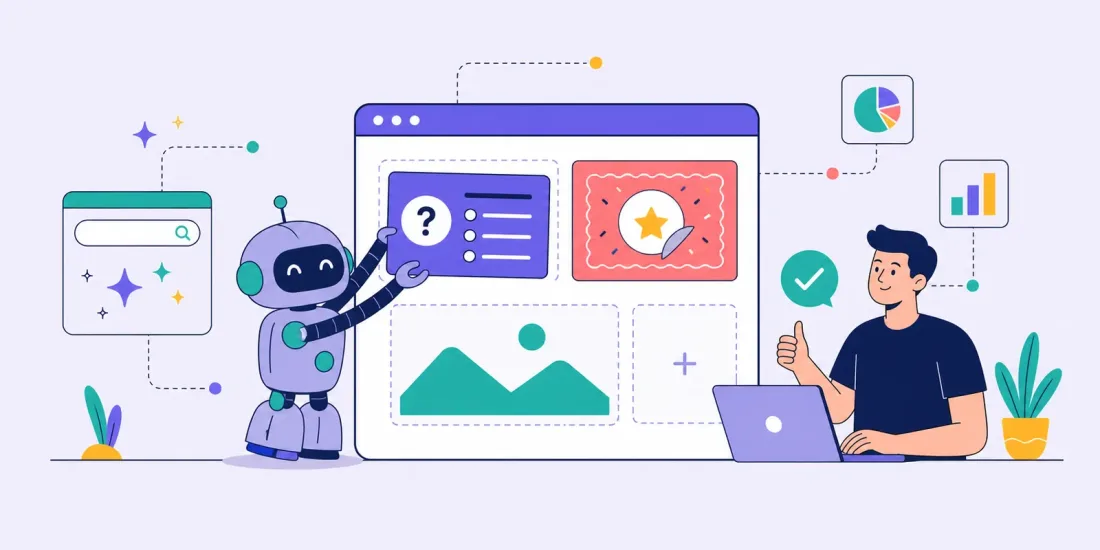
For campaign work, that means you describe what you want, and the AI builds it: the game, the texts, the design, the translations. This is already how Rex, the assistant in Scratcher, works. It reads your website, sets up your brand and drafts a campaign. You can see what to ask it in the help article what you can ask Rex.
The next step is connecting the AI you already use to your marketing tools. Open standards such as MCP make that possible, and we are building a Scratcher MCP server so tools like Claude and ChatGPT can work with your campaigns.
2. Many AI projects will be stopped, and that is healthy
Not every AI project will survive. Gartner predicts that over 40% of agentic AI projects will be cancelled by the end of 2027, because of costs, unclear value or weak risk controls.
Our take: the projects that survive will be narrow and measurable. "Build a Christmas calendar in our brand in ten minutes" is a good AI task. "Run our marketing" is not. Pick jobs where you can compare time and results before and after.
3. AI search shrinks traffic, so owned audiences grow in value
If AI answers the question, fewer people click through to your site. That does not make content pointless (AI tools need sources, and they cite them), but it does change the maths. Each visitor is harder to win, so turning visitors into subscribers becomes more important.
We expect 2027 budgets to shift from "more traffic" to "more from each visit": pop-ups that convert, newsletters people actually want, and campaigns that give people a reason to sign up. Our guides to email pop-up ideas and lead magnet ideas are a good start. For the email side, read our article on email and SMS marketing trends for 2027.
4. Shoppers arrive informed, so help them decide
Someone who comes from an AI assistant has often already compared options. They do not need a homepage. They need help with the last step. A product finder or a short product recommendation quiz fits this moment: a few questions, a clear answer, and a reason to leave an email for later.
It also gives you something AI cannot: the shopper's own words about what they need. That is zero-party data, and it makes every following email more relevant.
5. Content production becomes cheap, so authenticity becomes expensive
When anyone can make a hundred variants of an ad in a minute, generic content loses value. Gartner expects brands to direct half of their influencer marketing budgets to content authenticity and creator credibility by 2027.
In practice we expect more brands to put real people, real customers and real prizes in front. A game with a prize from your own range, a quiz written by your own experts, or a customer vote on next season's product all feel real in a way that generated content rarely does.
6. Transparency rules apply, and people want limits
The EU AI Act's transparency obligations started to apply in August 2026. They include telling people when they interact with a chatbot and marking certain AI-generated content, as summarised by Goodwin.
Consumers are cautious too. The Thales Digital Trust Index 2026 found that 77% are concerned about AI agents acting on their behalf online. We expect buyers to ask harder questions about AI in their tools: what data does it see, is it used for training, and can it be switched off? Scratcher's answers are in the security FAQ and the help article on AI tokens and privacy. Our article on first-party data and privacy trends for 2027 covers the wider picture.
7. People stay in charge of the things that matter
AI is good at drafts, variants, translations and reports. It is less good at judgement: whether a prize is fair, whether the terms are right, whether a joke fits the brand. In 2027 the best teams will make this split explicit.
- Let AI do: first drafts, translations into many languages, image ideas, social posts, quiz questions, summaries of results.
- Keep for people: the idea, the prize and the budget, the terms and the consent text, the final brand check, and anything legal.
This is how we built Rex: when something is missing, it asks rather than picks a value for you, as the help article on asking Rex to make changes explains. What Rex can't do covers the limits and how to reach a person.
What AI changes in gamified campaigns
For gamified marketing specifically, AI removes most of the slow work:
| Task | Before | With AI in 2027 |
|---|---|---|
| Design in your brand | Designer, brand guide, rounds of feedback | AI reads your website and sets up a brand kit |
| Quiz questions | Hours of writing and checking | AI drafts quiz questions, you check facts |
| Translation | Agency or colleagues in each market | Translate the whole campaign, then a native check |
| Social posts | Separate task after launch | Posts written with the campaign |
| Planning the year | Spreadsheet and gut feeling | AI plan generator as a first draft |
The time saved should go into better ideas and faster follow-up, not just more campaigns. Our older piece on how AI supercharges gamification marketing has more examples.
Three AI mistakes to avoid in 2027
Publishing without reading. AI drafts quickly and confidently, including facts that are wrong. Quiz answers, prize descriptions, dates and legal texts must be checked by a person before anything goes live.
Making more of the same. If AI lets you build ten campaigns in the time it used to take to build one, the temptation is to send ten times as much. Your audience will not read ten times as much. Use the time to make one campaign better, test it and follow up properly.
Feeding AI more data than it needs. Many tasks, such as writing a quiz or translating a campaign, need no personal data at all. Keep customer data out of AI tools unless there is a clear reason and a clear agreement, and choose tools that are built to work that way.
Each of these mistakes is easy to make in a busy team, and each can cost more than the time AI saved. A short written checklist, agreed before the next campaign, prevents most of them.
What to do now
- Pick three narrow AI jobs in your campaign process and measure time before and after.
- Write down your human checkpoints: who approves prizes, terms, consent text and brand.
- Move budget towards conversion: pop-ups, sign-up games and welcome flows that turn scarce visits into contacts.
- Make your site useful to AI: clear product facts, honest FAQs and pages that answer real questions.
- Ask your vendors about AI and data: what is sent where, what is stored, and whether it trains models.
- Collect declared data: add one useful question to your sign-up forms so you know what people want without guessing.
FAQ
What are the main AI marketing trends for 2027?
AI agents that build and run campaigns, AI search that reduces clicks, shoppers arriving from AI assistants better informed, a premium on authentic content, new EU transparency rules, and a clearer split between what AI does and what people decide.
Will AI replace marketers in 2027?
No. AI takes over drafts, translations and repetitive production, but ideas, prizes, legal checks and brand judgement still need people. Gartner also expects many agentic AI projects to be cancelled by the end of 2027, which shows how much depends on choosing the right tasks.
How does AI search affect lead generation?
Fewer people click through from search, so each visit is worth more. That makes conversion tools such as pop-ups, games and quizzes more important, and it makes owned channels such as email and SMS more valuable.
Is it safe to use AI with customer data?
It depends on the tool. Ask what data the AI can see, whether personal data is sent to the AI provider and whether it is used for training. In Scratcher, participants' names, email addresses and phone numbers are never sent to the AI provider, and the AI features can be turned off for an account on request.
Try AI on your next campaign
The quickest way to see what AI changes is to try it on a real campaign. Start a free 14-day trial and let Rex build your first game from your website, read meet Rex in the help center, or book a meeting to see it with our team.