


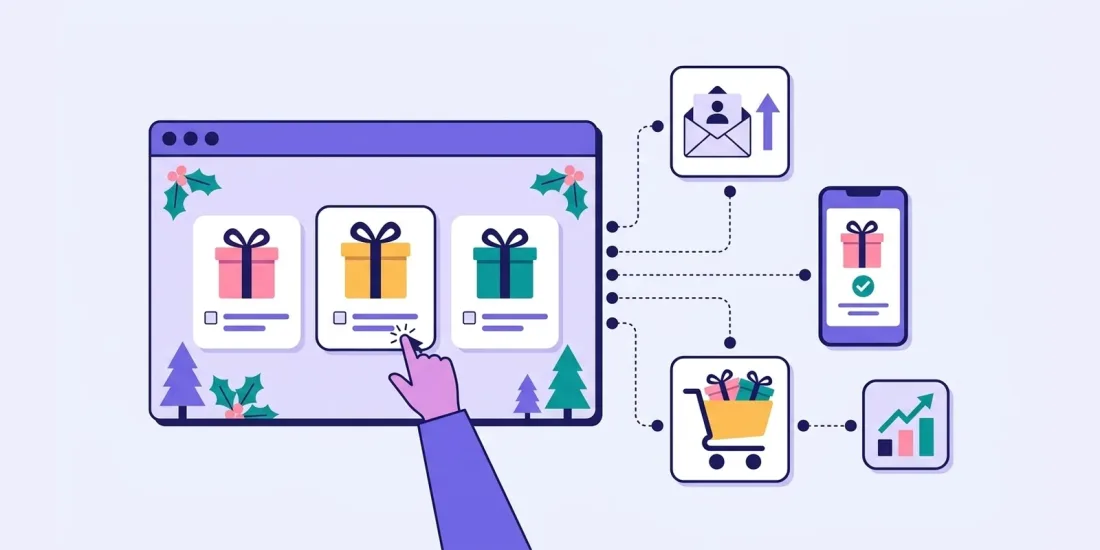
Every December, gift shoppers ask themselves the same question: "What should I buy for…?" They know the person, but not the product. A gift finder quiz answers that question on your own website. It asks a few simple questions about the person receiving the gift, recommends products that fit and sends the shopper straight to your webshop. Done well, it turns gift searches into leads and sales.
This guide shows you how to build a Christmas gift finder quiz step by step: designing the questions, mapping answers to products, capturing emails for the shortlist, promoting it in Q4 and measuring the results.
Why gift buyers need guidance
Buying a gift is harder than buying for yourself. The shopper is guessing at someone else's taste, size, hobbies and needs. Add a big product range, a deadline and a budget, and many people simply freeze.
That is when they leave your site to search elsewhere, ask friends or give up and buy a gift card.
A gift finder fixes that by working like a friendly shop assistant:
- It turns a big range into a short list. Instead of 2,000 products, the shopper sees two or three.
- It speaks the shopper's language. It asks about the person, not about product specs.
- It builds confidence. A recommendation that "fits Dad because he loves cooking" feels like advice, not an ad.
- It tells you what people want. Every answer is data about your customers and their gift lists.
This is guided selling, and it is one of the most practical ways to use gamification for sales. Our post on guided selling with gamification explains the idea in more depth.
How a gift finder quiz works in Scratcher
In Scratcher, a gift finder is built with the product finder format, a product recommendation quiz. People answer a few questions, and at the end they see the products that match, each with a picture, a short text and a link to buy.
You can set up the logic in three ways:
- Groups: sort the questions into levels, so each answer narrows the choice down step by step.
- Product per answer: link answers directly to specific products.
- Paths: map out your own routes through the questions for very precise recommendations.
You decide whether people must sign up before they see the result, or whether they can use the gift finder freely. You can run it as a Christmas campaign with prizes, or keep it on your website all season.
Designing recipient-based questions
The best gift finder questions are about the recipient, not the product. Most gift buyers do not know the difference between two technical features, but they know their sister runs every morning.
Start with who
The first question sets the scene: "Who are you buying for?"
- Partner
- Mum or Dad
- Child or teenager
- Friend
- Colleague
- Someone who has everything
This one answer already changes which products make sense.
Then ask about their life
Ask two to four questions about interests, habits and taste:
- "What do they love doing in their free time?" (cooking, sport, reading, gaming, travel, home)
- "Which of these sounds most like them?" (with pictures)
- "Practical or a little luxury?"
- "Do they like to try new things, or stick to their favourites?"
Use pictures as answers wherever you can. They are quicker to tap on a phone and more fun than text.
Finish with the budget
"How much would you like to spend?" is often best as the last question. By then the shopper is invested, and the budget helps you pick between products that fit equally well.
Keep it short
Three to six questions is usually enough. Every extra question should make the recommendation clearly better. If it does not, cut it.
Mapping answers to products
This is where many gift finders fail. Great questions are no use if the result feels random. Plan the mapping before you build anything.
Step 1: Pick your gift range
Choose the products you actually want to recommend this Christmas. Usually this means bestsellers, products with good stock and good margins, and a few gift-friendly items at different prices.
Step 2: Group them into gift profiles
Sort the products into a handful of profiles, such as "The home chef", "The active one", "The cosy type", "The tech lover" and "The one who has everything". Each profile should have products at a few price points.
Step 3: Connect answers to profiles
Decide which answers point to which profile, and which budget answers filter the products. For simple ranges, linking each answer to products is enough. For bigger ranges, groups or paths give you more control.
Step 4: Design the result page
The result page is where the sale happens:
- Show two or three products, not ten. Too many options bring the shopper back to square one.
- Explain why. "Perfect for someone who loves cooking" makes the recommendation feel personal.
- Add a clear button to each product page.
- Give a reason to buy now, such as a discount code or a note on the last delivery date before Christmas.
Step 5: Test it
Go through the gift finder as five different shoppers. Does each path end with products that make sense? Fix anything that feels off before you launch.
Capturing the email for the shortlist
A gift finder can be a strong lead generation tool, but only if the exchange feels fair. You have two main options.
Option 1: Sign-up before the result. People answer the questions and then fill in a short form to see their recommendations. This gives you more leads. To make it fair, offer something in return: a place in a prize draw, a Christmas discount code or a free gift with the order.
Option 2: Free result, optional sign-up. People see the result right away, and you invite them to sign up for a prize draw or a discount. This gives you fewer leads but less friction.
Which one is right depends on your goal. If list growth matters most in Q4, go with option 1 and a good incentive. If you want to remove every obstacle to the sale, go with option 2.
Either way, keep the form short. An email address and a clear newsletter permission are often enough. Then send the answers to your email tool or CRM with an integration, and follow up with a Christmas email flow based on what the shopper told you: products for "the home chef", a reminder before the last delivery date and a final nudge for last-minute buyers.
Proof that product quizzes generate leads
Zapp, which sells EV charging boxes, used a product recommendation quiz to help people choose the right charger. In its first two months, the quiz brought in 834 leads at a cost of around €1.50 per lead, and 10% of participants went on to buy. Christmas gifts are a different product, but the principle is the same: useful advice is a strong reason to sign up. Read the full Zapp story.
Promoting your gift finder in Q4
A gift finder only works if people find it. Plan where it will live and how you will drive traffic to it.
On your website
- A gift finder pop-up on your gift guide and category pages. Set it to appear after a few seconds or when someone scrolls, so it reaches people who are browsing without a plan. See how game pop-ups work.
- Embedded on your gift guide page, so it is part of the shopping experience.
- A banner on your front page during the busiest weeks.
In your channels
- Newsletter: "Not sure what to buy? Let us help." is a strong subject line in December.
- Social media and ads: send traffic straight to the gift finder rather than a general landing page.
- In store: a QR code on a sign near the gift section lets shoppers get advice on their phone when staff are busy.
Timing
Launch your gift finder in November, before Black Friday, so it helps early shoppers and collects leads you can nurture through December. Keep it running until your last delivery date, and consider switching the result page to gift cards and click-and-collect for the final days.
KPIs to track
Decide on your KPIs before launch. For a gift finder, these are the most useful:
- Start rate: the share of visitors who start the quiz
- Completion rate: the share who reach the result page
- Sign-up rate: the share who leave their email
- Click-through to products: the share who click a recommended product
- Sales from recommended products, tracked in your webshop
- Most common answers: which recipient types and interests are most popular, useful for next year's range and gift guide
If the start rate is low, look at the placement and the first screen. If many start but few finish, cut questions. If many finish but few click, look at the result page and the products you recommend. Our page on how to increase sales with interactive campaigns has more ideas for turning players into buyers.
Make this the year your gift guide talks back
A static gift guide hopes that shoppers find something. A gift finder quiz asks them what they need and answers. It is more helpful for the shopper, more useful for you and, with a good incentive, a reliable source of Christmas leads. For more seasonal inspiration, see our Christmas campaign ideas.
Ready to build yours? Start a free 14-day trial, pick a product finder template and add your gift range.