


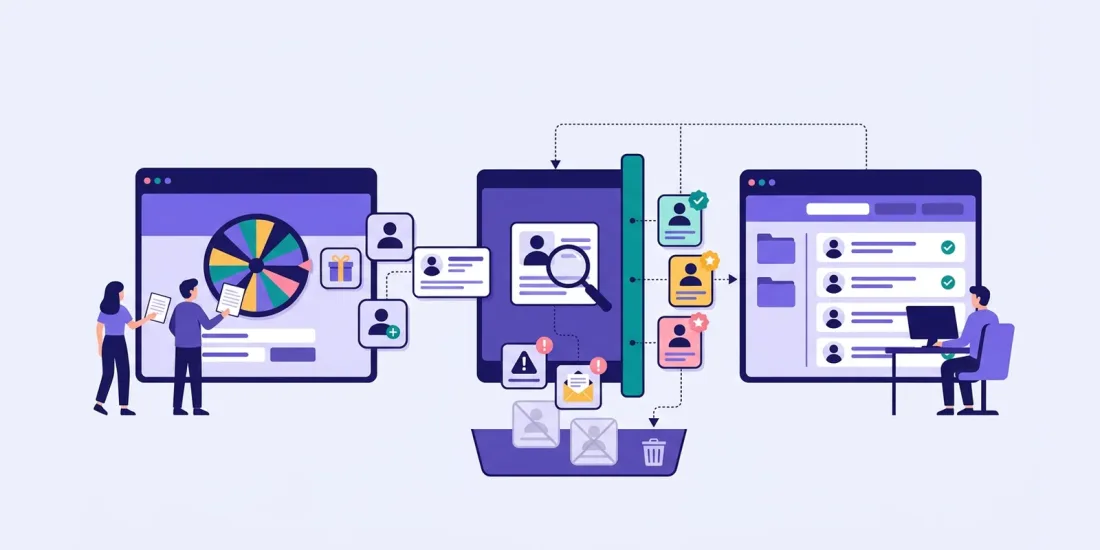
Giveaway fraud is when people or bots enter a competition with fake, duplicate or borrowed details to win more often. You stop most of it by allowing one entry per email or phone number, limiting plays, adding reCAPTCHA and an email verification code, blocking throwaway email addresses, and checking the entries before you draw winners. Prize hunters are a different problem, and you solve that with the right prize and a few qualifying questions.
"Competitions only attract prize hunters." If you work in marketing, you've heard it, and you may have seen it: a giveaway brings in thousands of sign-ups, a handful of addresses look suspicious, and a month later most of the list has never opened an email. It doesn't have to be that way. This guide covers both sides: how to spot and stop fake entries, and how to design a competition that attracts future customers instead of people who enter everything.
Fake entries vs prize hunters
These two get mixed up, but they need different fixes.
| Fake entries | Prize hunters | |
|---|---|---|
| Who | Bots, scripts and people using several identities | Real people who enter many competitions, whatever the brand |
| Goal | Win more often than the rules allow | Win something, anything |
| Harm | Unfair draws, wasted prizes, junk in your list | Low engagement and unsubscribes after the competition |
| Fix | Entry limits, verification and block lists | Relevant prizes, qualifying questions and the right channels |
Prize hunters aren't cheating. They play by the rules, they're just not interested in you. Fake entries break the rules, and your terms should say so.
Signs of fake entries
Most organisers notice fraud when they look at the entries list. These are the patterns to look for:
- Bursts of entries in a short time, often from the same IP address. Real people trickle in; scripts arrive in waves.
- Throwaway email addresses from disposable email services, which people use once and never check again.
- Patterns in email addresses, such as the same name with a number added (anna.k1, anna.k2, anna.k3) or many addresses on an unknown domain.
- Patterns in names and addresses: random letters, the same postal address written in slightly different ways, or the same phone number with different names.
- Entries that all fill in optional fields the same way, or answer qualifying questions identically.
- Winners who don't respond or can't confirm basic details when you contact them.
One odd entry isn't proof of anything. A pattern is a reason to look closer.
How to prevent giveaway fraud: what to set up
The best defence is to stop fake entries before they're made. In Scratcher, these settings are available on every online competition:
| Setting | What it stops | When to use it |
|---|---|---|
| One entry per email address or phone number | The same person entering again and again | Always |
| Play limits | Unlimited plays to fish for a prize | Always; choose how often people can play and win |
| reCAPTCHA | Bots and scripts | Any public competition, especially with paid traffic |
| Email verification code before playing | Fake and mistyped addresses, entries with other people's emails | Valuable prizes, or when you want a clean list |
| Disposable email blocking | Throwaway addresses | Always for lead generation |
| Block lists for emails and domains | Known fraudsters and suspicious domains | When you spot a pattern, or reuse lists between campaigns |
| IP rate limiting | Bursts of entries from the same IP address | Any public competition; normal players hardly notice it |
Not every campaign needs every check. A quick pop-up for existing visitors can stay light. A competition with a valuable prize, paid traffic or a spot on giveaway listing sites should be strict. Each check you add stops more fraud but can also put off a few honest people, so match the friction to the size of the prize.
Two more things help:
- Write it into your terms. Your terms should say that automated, duplicate and fake entries are invalid and can be removed. Our competition terms and conditions template has a clause you can copy.
- Use double opt-in if you send sign-ups to your newsletter. Only people who confirm their email are counted as subscribers. Double opt-in emails are part of the Email module, included on Professional.
What to do before you draw winners
Fraud that gets past your settings usually shows up at the draw. Build these steps into your plan:
- Export the entries and sort them by time, email domain and name. Bursts and patterns are easy to see in a spreadsheet.
- Remove invalid entries according to your terms, and add any suspicious addresses or domains to your block list for the rest of the campaign.
- Draw the winners, and draw a few reserves at the same time in case you need them.
- Verify winners before you hand over the prize. Ask them to confirm their details, and check that the name and address make sense.
- Keep a record of how the draw was made and which entries you removed and why.
In Scratcher, automatic draws can run daily, weekly, monthly or at the end of the campaign, and winners and entries can be exported. If a draw runs automatically, check the winners before you contact them. See how prizes and winners work, and read our guide on how to pick a giveaway winner for the draw itself.
The free email list checker finds duplicates, typos and throwaway addresses in an exported list before you draw.
Why competitions attract prize hunters
Fraud is the loud problem. Prize hunters are the quiet one: real people who enter because there's a prize, not because of your brand. Three design choices make it worse:
- A generic, expensive prize. A tablet or a cash prize appeals to everyone, including people with no interest in what you sell.
- No link to your products. If the campaign could belong to any company, so could the people who join it.
- The wrong channels. Websites and groups that list giveaways send people who enter everything.
Relevant prizes beat expensive prizes
The prize is the most effective lever for lead quality. A prize from your own range attracts people who want your products.
POWER, the Nordic electronics retailer, picks popular products that often feature in its own marketing. People recognise a product from a TV ad and then discover they can win it in the game. POWER's Black Friday wheel brought in 60,000 new email permissions in two weeks, and POWER's Group Omnichannel Director says that, in his experience, generally over 50% of those who engage in a Scratcher game convert within a reasonable period.
- Use your own products or gift cards instead of generic electronics or cash.
- Give everyone a small, relevant reward, like a discount code or free shipping. It turns taking part into a reason to visit your shop.
- Match the prize to the audience you want. A furniture shop that gives away a recognisable piece from its own range attracts people who like that style.
- Spread the prizes out. Daily or weekly draws keep people coming back.
Qualifying questions and quizzes
Add a little effort, and you filter out people with no interest.
- Ask one or two qualifying questions on the form, such as "Which products are you interested in?" or "Are you planning to buy in the next six months?".
- Use a quiz instead of pure luck. People who answer questions about your brand learn something about you, and their answers show how interested they are.
- Use a product finder or personality test that ends with a recommendation. Only people who care about the result will finish.
Toyota Denmark built its campaigns around educational quizzes about electric cars, with the chance to win a new car. The answers feed personalised email flows, and Toyota reports a conversion rate of about 7% for competition-sourced leads, close to the roughly 9% of its standard "get a quote" flow. The team adjusted messaging and mechanics over time to trade some volume for quality.
Where the traffic comes from
The channel you promote a competition in shapes who enters.
- Start with owned channels: your website, a pop-up, your newsletter, your social media profiles and your stores.
- Target paid ads at your customer profile, not at "people who like competitions".
- Use a separate link for each channel, so you can see which sources bring sign-ups that later open, click and buy, and switch off the rest.
Be clear about consent too. Make it as easy to see that people are signing up for marketing as it is to see what they can win. People who know what they signed up for are more likely to open your emails. How consent must be collected differs between countries, so check the current rules for your market and read more on our page about collecting sign-ups with consent.
Measure lead quality after the competition
The number of sign-ups is the easiest metric and the least useful on its own. Measure what happens afterwards:
- Confirmation rate, if you use double opt-in
- Open and click rates compared with other sign-up sources
- Unsubscribe rate in the first month
- Purchase rate within 30, 90 and 180 days
- Average order value compared with other subscribers
Whiteaway, Denmark's largest online retailer of white goods, measured exactly this after a wheel of fortune advent calendar. Six months later, 82% of the new subscribers were still subscribed, and participants had a 20% higher average order value than people who had signed up for the newsletter in other ways.
Tag every sign-up with its campaign and source, and Scratcher's analytics show visits, players and sign-ups per channel. Send the campaign name with each sign-up to your email tool or CRM, so you can follow each group over time. Then start with a strong welcome flow, and after 60 to 90 days send a re-engagement email to people who have never opened.
FAQ
How common is giveaway fraud?
It depends on the prize and where the competition is shared. Competitions with valuable prizes that are listed on giveaway sites get far more attempts than a pop-up for your own visitors. Look at your own entries list rather than relying on general figures.
Can I disqualify fake entries?
You can if your terms say so. Add a clause that automated, duplicate and fake entries are invalid, and check the details with your lawyer. Our terms and conditions template includes one.
Does reCAPTCHA stop all fake entries?
No. It keeps out most bots, but not real people with several email addresses. Combine it with one entry per email or phone number, an email verification code and disposable email blocking.
Are prize hunters bad for my list?
Not always. Some become customers. But if most of a competition's sign-ups never open an email, change the prize, add a qualifying question or move the promotion to your own channels.
What should I check before I announce the winner?
Export the entries, remove invalid ones according to your terms, draw the winner and a few reserves, and confirm the winner's details before you announce anything.
Run a fair competition that brings in customers
- Allow one entry per email or phone number, and limit plays.
- Add reCAPTCHA, an email verification code and disposable email blocking when the prize is worth cheating for.
- Check entries and verify winners before you hand out prizes.
- Pick prizes from your own range, and add a question or a quiz.
- Measure what happens after the sign-up.
Planning your first one? Our guide on how to run an online competition takes you from prize to winner. Or start a free 14-day trial and set up a competition with entry limits and verification today. Want help choosing the right checks? Book a meeting.
This article is general information, not legal advice. Rules differ between countries and change over time, so check the current rules and get legal advice before you launch a campaign.