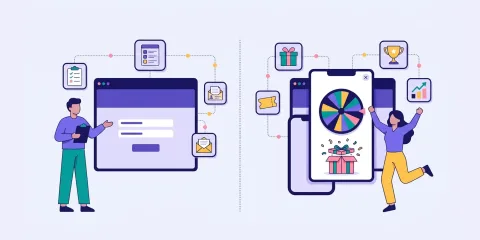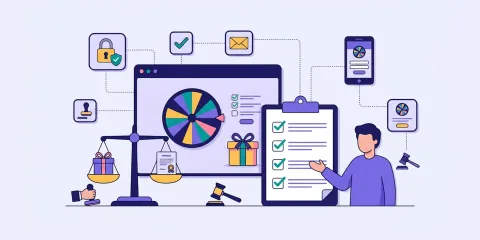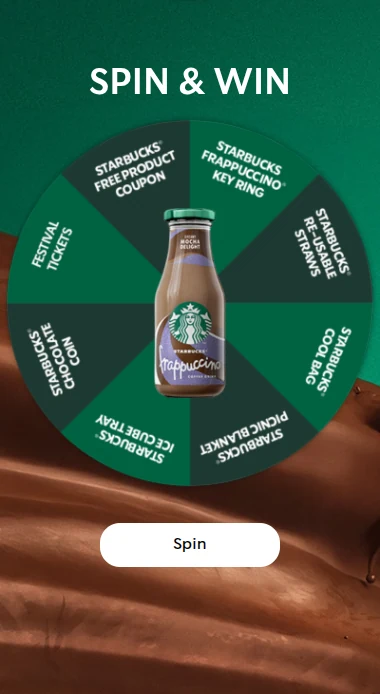




Clients increasingly ask their agencies for campaigns people can actually take part in: a wheel to spin, a quiz to answer, a calendar to open. If you run a digital, creative or activation agency, interactive campaigns are a natural addition to your agency marketing services. They're quick to produce, easy to measure and they give your clients something they can't get from another banner: sign-ups, consent and first-party data.
This guide covers why clients want gamification, how to package it as a service, how to run the workflow across many brands, how to report on it and which pitfalls to avoid.
Why clients ask for interactive campaigns
The brief usually sounds familiar. The client spends more on media every year, but fewer people engage. Forms feel like work, and ads get scrolled past. What they want is attention that turns into something they can use.
A game answers that brief in a way that's easy to explain to a marketing director:
- People choose to take part. A scratch card or a prize wheel feels like a small gift, not a form, so more people finish.
- Every play can leave data behind. Name, email, consent to marketing and answers to a few questions go straight to the client's email tool or CRM.
- It works in every channel. The same campaign can be a landing page, a pop-up on the client's website, a link in a newsletter or SMS, or a QR code in a store or at an event.
- Results are visible quickly. Visits, players, sign-ups and winners show up while the campaign is live.
Norwegian agency Nova Vista, which works with brands such as Pepsi Max, 7Up, Rema 1000 and Audi, had been running physical prize wheels at activations. A physical wheel could reach 25 to 30 people an hour. When they moved to a digital wheel, around 11,000 people took part. They aimed for a 50% conversion rate and reached 89%. You can read the full Nova Vista story here.
Packaging gamification in your agency marketing services
Clients buy outcomes, not game mechanics. Package your offer around the problems they already talk about, for example:
- List growth. A seasonal game that grows the newsletter or customer club, connected to the client's email tool.
- Product launch or sampling. A mystery box or scratch card with free products and coupons, plus a short survey for people who tried the product.
- Retail activation. QR codes in store or at events that lead to a digital game, so footfall turns into contacts.
- Always-on engagement. A calendar of four to six campaigns a year, planned around the client's key seasons.
- Data and personalisation. A quiz, personality test or product finder that sorts people by interest, with the answers sent to the CRM.
For each package, define what's included: concept, design, copy, prize mechanics, set-up of integrations, launch support and a results report. That makes the offer easy to buy and easy to repeat.
A tip: keep the creative idea as your agency's core value, and let the platform handle the heavy lifting. With 40+ formats and 150+ ready-made templates, your team rarely needs to start from scratch.
Workflow: templates, approvals and multi-brand work
Delivering interactive campaigns for many clients only pays off if the workflow is efficient. This is what to look for, and how it works in Scratcher's agency set-up.
One account per client
Create and manage a separate account for each client, so brands, data and integrations never get mixed up. You switch between clients with one login.
Roles for your team
Give designers, copywriters and campaign managers the access they need, and nothing more. Clients can also get access to their own results.
Brand consistency
Remove the Scratcher logo and use each client's colours, fonts and logo. Design kits let you save a client's look once and reuse it. Rex, the AI assistant, can build a design kit from a client's website and translate a whole campaign, which helps when one client runs in several markets.
Approvals before launch
Share a demo link so the client can see and try the campaign before it goes live. Collect feedback in one round, adjust and publish.
Reuse what works
Once a concept has worked for one client, adapt it for the next. Start from your own previous campaign or a template, change the brand, prizes and texts, and you're ready.
Reporting to clients
Reporting is where many agencies win or lose the next brief. Agree the main KPI with the client before launch, so the report answers the question they actually care about.
Good numbers to include:
- Visits, players and sign-ups, and the conversion between them
- New marketing permissions and how many went to the client's email tool or CRM
- Where people came from, so the client sees which channels worked
- Cost per lead, if you have the media spend and prize costs
- Prize redemptions or sales, if the campaign gave out codes
Scratcher's statistics update in near real time, and you can download a report as a PDF in one click. On the Professional plan, or with an add-on, you can build custom dashboards, and the AI report gives a written summary of how the campaign did. Our post on gamification marketing KPIs lists more metrics to choose from.
Pricing models for your clients
How you charge depends on your agency, but three models are common for interactive work:
- Per campaign. A fixed fee covering concept, build, launch and report. Easy for clients to approve, and a good way to start.
- Retainer. A set number of campaigns per year, planned around the client's seasons. This gives you predictable revenue and the client a steady stream of activity.
- Platform plus services. The client pays for their own licence, and you charge for strategy, design and campaign management.
Whichever model you choose, separate the costs that scale with the campaign, such as prizes and media, from your own fee. It keeps quotes clear and avoids surprises.
On the platform side, Scratcher has an Enterprise and agency plan for agencies that manage many clients, with many accounts, unlimited users and languages and your own success manager. The price depends on how many clients, accounts and users you need, so it's set in a meeting. You can see the standard plans on our pricing page.
Pitfalls to avoid
A few things trip up agencies new to interactive campaigns:
- Too many form fields. Every extra field costs participants. Ask only for what the client will actually use.
- A prize nobody wants. The prize doesn't have to be expensive, but it should fit the brand and the audience. A discount code or the client's own product often works better than a generic gadget.
- Unclear consent. If the campaign collects marketing permissions, the consent text should be clear and separate from the game. Make sure the client signs off on the wording and the terms, and checks them with their legal adviser. The client is responsible for its own campaign.
- No activation plan. A great game with no traffic is wasted. Plan the newsletter, social posts, ads, pop-ups or QR codes before launch.
- Forgetting the follow-up. The sign-ups are only worth something if the client uses them. Agree on a welcome email or flow before the campaign starts.
- Reporting on vanity numbers. Plays look nice, but clients renew for permissions, data and sales. Lead with those.
Getting started
Adding gamification to your agency marketing services doesn't require a development team. Pick one client with a clear goal, build a campaign from a template, share a demo link for approval and report on the results. Then turn it into a package you can sell again.
Want to hear how Scratcher can work for your agency and your clients? Book a meeting with our team, or try Scratcher free for 14 days and build your first client campaign today.