


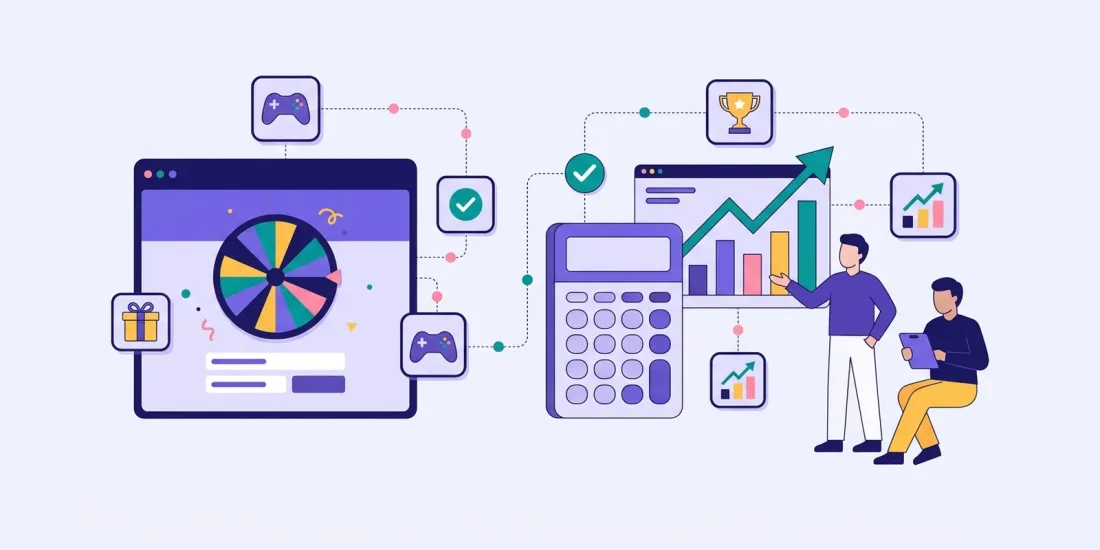
Gamification ROI is the value a gamified campaign creates in leads, permissions, sales and data, minus its total cost, divided by that cost and multiplied by 100. Count only the values you can measure, include licence, prizes, media and time, and compare with your own baseline. A clear break-even point is often more convincing for a CMO than an ROI estimate.
"It looks fun, but what do we get for the money?" If you've pitched a gamified campaign to your CMO, you've probably heard that question. The answer is gamification ROI: a clear calculation of what the campaign costs and what it brings back in leads, permissions, sales and data. This guide gives you a simple model, a worked example and the arguments you need to make the case.
Which value to count
The first mistake many teams make is counting only one thing, usually sales. A gamified campaign often creates value in several ways, and some of them pay off months later. List them all, then decide which ones you can put a number on.
- Leads. New contacts with a name and email. You probably already know what a lead costs you through other channels, such as paid social or lead ads.
- Marketing permissions. A lead with consent to receive marketing is worth more than one without, because you can contact them again and again at almost no cost.
- Sales. Orders placed with a prize code, or purchases by participants in the weeks after the campaign.
- Data. Answers to quiz or personality-test questions that let you segment and personalise. Harder to value, but real.
- Reactivation and loyalty. Existing customers who come back, log in or join your club.
For a business case, focus on the two or three values you can measure with confidence. Mention the rest as upside.
The cost side
Be honest about costs. A CMO trusts a calculation more when nothing is left out. Typical costs are:
- Platform licence. For Scratcher, see our pricing page. Basic costs €399 a month, billed monthly or yearly, with up to 50,000 leads or participants.
- Prizes. Grand prizes plus any consolation prizes, such as discount codes. Remember that a discount code only costs you something when it's used.
- Media. Ads, boosted posts or paid placements that drive traffic to the game.
- Time. Hours spent on concept, design, copy, set-up and follow-up. If an agency helps, include its fee.
- Follow-up. The emails or flows that turn new leads into customers.
The gamification ROI formula, with a worked example
The standard formula is:
ROI = (value created − total cost) ÷ total cost × 100
Here's a worked example. The numbers are made up to show the method. Use your own figures.
Costs for one month
- Platform licence: €399
- Prizes: €500 grand prize plus discount codes that cost you €300 when used
- Media: €600
- Internal time: 10 hours at €50 = €500
- Total cost: €2,300
Value created
- 2,000 new marketing permissions. Let's say your other channels pay €1.50 for a comparable lead, so the replacement value is €3,000.
- Sales from discount codes: 150 orders with an average margin of €20 = €3,000 in gross profit.
- Total value: €6,000
ROI = (€6,000 − €2,300) ÷ €2,300 × 100 ≈ 161%
Two notes on this method:
- Use margin, not revenue. A €100 order with a 30% margin creates €30 of value. Using revenue inflates ROI and will be spotted.
- Don't double count. If you value leads by what they'd cost elsewhere, don't also add the future sales from those same leads. Pick one, or use the lifetime value approach below instead.
Lifetime value of a permission
The campaign itself is only the start. A permission keeps creating value every time you send a newsletter. That's why the lifetime value of a permission is often the strongest argument for gamification.
A simple way to estimate it:
- Find your revenue per subscriber. Take the revenue your email channel generated over the last 12 months and divide it by your average number of subscribers.
- Convert to margin. Multiply by your gross margin.
- Adjust for how long people stay. If subscribers stay on your list for two years on average, multiply by two.
The result is roughly what one new permission is worth to you. Multiply it by the number of permissions the campaign brought in, and you have a value that most CMOs recognise.
Then check that the new subscribers behave like the old ones. Whiteaway did exactly that: six months after its advent calendar campaign, 82% of the new subscribers were still on the list, and participants had a 20% higher average order value than people who had signed up for the newsletter in other ways.
Benchmarks: use your own baseline
It's tempting to compare your campaign with an industry average conversion rate or cost per lead. Be careful. Published benchmarks mix very different audiences, prizes and channels, and they're often based on a vendor's own data.
A stronger approach is to compare with your own baseline:
- Cost per lead from your existing channels, such as lead ads, pop-up forms or paid social
- Conversion rate of your current newsletter sign-up form
- Revenue per subscriber from your email reports
- Results of your previous campaign, if you've run one
Compare the gamified campaign with what you'd have done otherwise. That's the question your CMO is really asking. Our post on gamification marketing KPIs lists the metrics worth tracking.
Building the business case slide
Keep it to one slide. A CMO wants to see the logic quickly, then ask questions. A structure that works:
- The goal. "Grow our newsletter by 5,000 permissions before Black Friday."
- The baseline. "Today, a new permission costs us €X through lead ads."
- The plan. Format, prize, channels and timing in one line each.
- The cost. Licence, prizes, media and time, with a total.
- The expected value. Leads × lead value, or permissions × lifetime value, plus expected sales from codes.
- The break-even point. "We break even at 1,500 permissions." This is often more convincing than an ROI estimate, because it's easy to judge.
- How we'll measure it. Which numbers you'll report and when.
During the campaign, Scratcher's statistics show visits, players, sign-ups and winners in near real time, and which channels bring people in. You can download a report as a PDF in one click, and with Google Analytics or your ad pixels you can follow the campaign in the tools you already use.
Case examples with published ROI
Real numbers from our customers help put your estimate into context. These are their results, not benchmarks for yours.
- Rascals Brewing ran a branded wheel of fortune with beer and discount codes as prizes. The result was a 259% ROI, including marketing spend, prizes and the cost of Scratcher, as well as 275% monthly growth in newsletter subscribers and 35% more orders. In a later newsletter, 33% of orders came from people who had signed up through the game.
- Zapp Mobility used a quiz that helped electric car owners choose a charging box. With €550 in marketing spend, it generated 834 leads at €1.50 each, and 10% of participants went on to buy. Read the Zapp story.
- BOBO, an online furniture store, used a wheel of fortune with a gift card grand prize and 1,000 small gift cards as consolation prizes. It reached 6,845 participants and its lowest-ever cost per lead: €0.18. Read the BOBO story.
- EYDA sent Meta ads straight to a true-or-false brand quiz and generated 12,000 leads over three months at €0.30 per lead, 35% cheaper than its usual ads.
Notice the pattern: each of them had a clear goal, a prize that fitted the audience and a way to measure the result.
Make the case, then prove it
Gamification ROI isn't hard to calculate. Count the values you can measure, include every cost, compare with your own baseline and show the break-even point. Then run the campaign, report honestly and use the result to plan the next one.
Want to test the numbers on your own audience? Try Scratcher free for 14 days, no credit card required, or book a meeting and we'll help you build the business case.