


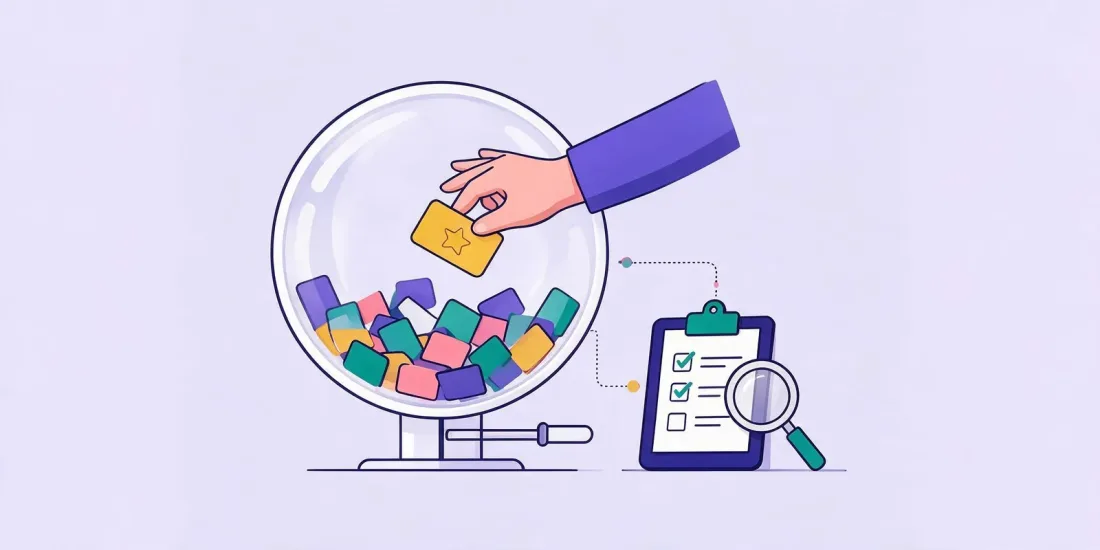
To pick a giveaway winner fairly, close the giveaway on time, put every valid entry in one list, remove duplicates and entries that break your rules, and then pick a random winner with a tool that gives every entry the same chance. Document the draw, draw a few reserve winners, give the winner a clear deadline to claim the prize, and announce them in a way that respects their privacy, such as first name and city.
The draw is the moment your participants find out if the competition was fair. Get it right and people trust you enough to enter again. Get it wrong, or fail to explain it, and the comments fill up with questions. This guide walks through choosing between a random draw and a judged competition, cleaning the entry list, running and documenting the draw, contacting winners, re-draws, and how to announce a giveaway winner.
Random Draw or Judged Competition?
Start by checking what your rules promise, because the method has to match.
- Random draw. Every valid entry has the same chance. Use it for giveaways where people enter by signing up, playing a game of chance or answering an easy question. Read more about instant wins vs prize draws.
- Judged competition. A jury picks the best entry against criteria you state in advance, such as the most creative photo or the best answer to "why should you win?". Write down the criteria and who judges.
- Skill competition. The best result wins, for example the highest score in a skill game. Say in advance how you handle a tie. See our guide to leaderboards and skill games.
Whatever you choose, don't change the method after the competition has started. In the UK, the line between a prize draw and a competition has its own rules; see prize draw vs competition in the UK.
Step 1: Clean the Entry List Before You Draw
A fair draw starts with a fair list. Before you pick anyone:
- Close the competition on time. Entries after the closing time don't count. Note the time you closed it.
- Collect every entry in one place. Export from your form or competition tool, or copy usernames if people entered by commenting.
- Remove entries that break the rules. People outside the allowed countries, under the age limit, your own employees if your rules exclude them, and incomplete entries.
- Remove duplicates. If your rules say one entry per person, keep one. Look for variations that are easy to miss, like the same name with several email addresses, or extra dots and plus signs in an address.
- Remove obvious fakes. Throwaway email addresses, bots and accounts made only to enter giveaways. Our article on prize hunters and fake sign-ups explains how to spot them, and how to stop them before they enter.
The easiest way to keep the list clean is to stop bad entries at the door: one entry per email address or phone number, reCAPTCHA, and blocking throwaway email addresses.
Step 2: Pick a Random Winner
Use a method where every valid entry has the same chance and where nobody can influence the result.
- For small lists: a random number generator or a picker tool that draws from a list. Our free random winner picker takes a pasted list, removes duplicates and draws in your browser, so the list never leaves your computer.
- For big campaigns: let the competition platform run the draw from the entry list, so nobody has to export, clean and paste thousands of rows by hand.
Avoid methods that are hard to explain, like picking "a comment that stood out" in a giveaway you described as random.
Running the giveaway in the comments? Our free comment pickers draw a winner and reserves from the Instagram comments, Facebook comments, TikTok comments or YouTube comments you paste in. For a draw people can watch on screen, use the free wheel spinner.
Step 3: Document the Draw
If someone asks how the winner was found, you want a clear answer. Keep a short record:
- Date and time of the draw
- How many valid entries there were, and how many you removed and why
- The method or tool you used
- The winner and reserve winners
- Who ran the draw (two people is better than one)
A screenshot or screen recording of the draw is often enough for a small giveaway. For bigger prizes, some organisers ask an independent person to witness the draw. Keep the record together with your terms for the competition.
Step 4: Contact the Winner and Set a Deadline
Contact the winner the way your terms say: by email, phone or a message from your official account. Tell them:
- What they have won
- What they need to do to claim it, and what information you need (for example a delivery address)
- The deadline to reply, such as 7 or 14 days
- What happens if they don't reply
Only ask for what you need to deliver the prize. Never ask a winner to pay a fee or share card details. Fake accounts sometimes copy brands and send "you won" messages, so tell your participants up front how you will contact winners.
Step 5: Re-draws When a Winner Doesn't Reply
Draw one or two reserve winners at the same time as the main winner and in the same documented way. If the winner doesn't reply before the deadline, or turns out not to meet the rules, move to the first reserve. Note the reason in your record.
State the re-draw rule in your terms before the competition starts: how long winners have to claim, and that an unclaimed prize goes to a reserve. Our competition terms and conditions checklist covers this and the other usual topics.
Step 6: How to Announce a Giveaway Winner
Announcing the winner shows that someone really won, and gives you a reason to contact everyone again. But a winner's name is personal data.
- Say how you will announce winners in your terms and privacy information, before people enter. Under the GDPR, people must be told what their data is used for when it is collected (Article 13).
- Share as little as possible. First name and city, or first name and the first letter of the surname, is a common choice. The GDPR's data minimisation principle says personal data should be limited to what is necessary for the purpose (Article 5(1)(c)).
- Ask before you show more. A photo, full name or social media handle should only be shared if the winner agrees. Check with your lawyer how to ask and record that.
- Thank everyone else. A small discount code for all participants turns the announcement into a reason to visit your shop.
For ideas on wording and channels, read how to announce a competition, which covers the launch and the winner announcement.
Automatic Prize Draws in Scratcher
In Scratcher, the draw is part of the competition itself, so there is no exporting, cleaning or pasting:
- Automatic prize draws daily, weekly, monthly, at an interval, on a set campaign day or at the end of the campaign. Scratcher picks the winners at the times you choose.
- Skill draws that pick winners by best score, for skill games and leaderboards.
- Clean entries from the start: one entry per email address or phone number, limits on how often people can play, reCAPTCHA, an optional verification code before playing, blocked throwaway email addresses, block lists and IP rate limiting.
- Winner emails sent for you with the Email module (included on Professional, or as an add-on), or contact winners of manual prizes yourself.
- Export of entries and winners, so you can keep a record of every draw.
See how prizes and winners work, or read more about online competitions and giveaways. If you are planning the whole campaign, start with our guide on how to run an online competition.
FAQ
What is the fairest way to pick a random winner?
Put every valid entry in one list, remove duplicates and entries that break the rules, and use a random number generator or an automatic draw that gives each entry the same chance. Document the draw so you can explain it.
How long should a winner have to claim a prize?
There is no single rule. Many organisers give 7 to 14 days. Choose a period, state it in your terms, and say what happens if the winner doesn't reply.
Do I have to publish the winner's name?
Not necessarily. Many brands share only a first name and city, or ask the winner first. Tell participants in your terms how winners are announced, and get legal advice on what fits your market.
Can I pick the winner myself instead of drawing at random?
Only if your rules say the winner is chosen by a jury or by best result, with criteria stated in advance. If you promised a random draw, draw at random.
Let the Draw Run Itself
Set up your prizes once, and Scratcher picks the winners at the times you choose. Try Scratcher free for 14 days, no credit card needed, or book a meeting and we'll show you how draws work.
This article is general information, not legal advice. Rules differ between countries and change over time, so check the current rules and get legal advice before you launch a campaign.