


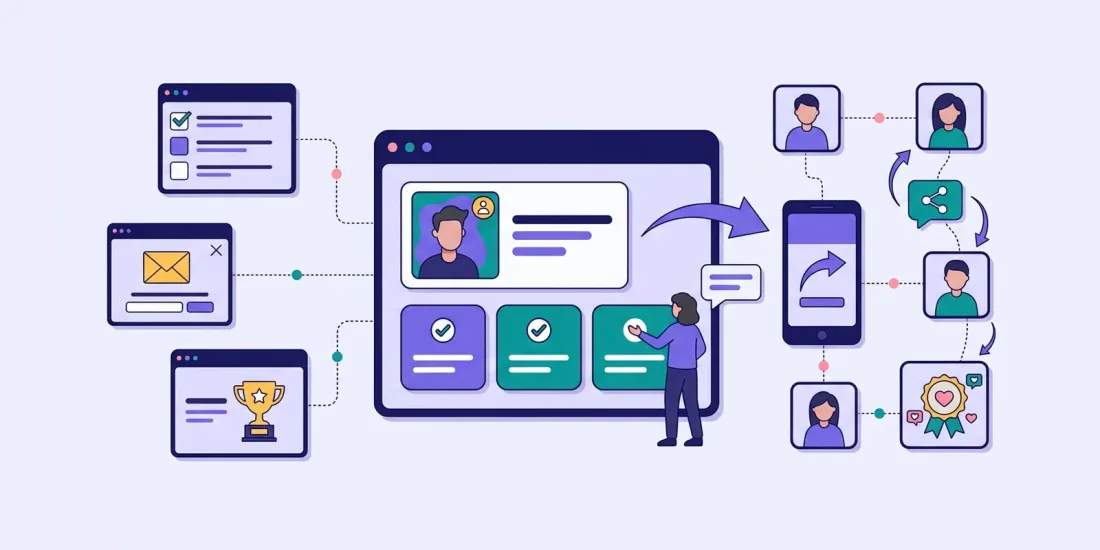
Personality quiz marketing gives people a fun, shareable result about themselves, such as a spirit animal or a type of traveller, in return for finishing a quiz and leaving their email. Start with three to six results tied to your products, write five to eight light questions that give points to each result, and use the answers to segment your emails.
"Which spirit animal are you?" "What kind of traveller are you?" "What's your skincare type?" We have all clicked on one, and most of us have shared the result. That is the whole idea behind personality quiz marketing: give people a fun result about themselves, and they will happily finish the quiz, leave their email and tell their friends.
This guide shows you how to build a personality test for your brand that people actually share, and how to turn the results into segments and sales afterwards.
Why personality quiz marketing works: results are shareable
A normal quiz has right and wrong answers. A personality test does not. Everyone gets a result, and the result is about them. That small difference changes how people feel about it:
- It is about me. People like learning something about themselves, even when they know it is just for fun.
- There is no way to fail. Nobody feels stupid, so more people finish.
- The result says something. Sharing "I'm a fox" or "I'm an adventure traveller" is a small way of showing who you are.
- Friends want to compare. When one person shares a result, their friends want to find out theirs.
That is why a personality test can travel further than most campaigns. WWF Denmark is a good example. Its Spirit Animal test, where people answered simple questions and were matched with an animal like a fox or a hedgehog, was something the organisation "would never normally do". Over six months it reached 10,557 participants, with an average engagement time of 2 minutes and 33 seconds, and most of the traffic came from Facebook. Read the WWF Denmark story.
Designing result types around products
The most common mistake is to start with the questions. Start with the results instead. A personality test for brands should end in something useful, not just a funny label.
Pick three to six results
Fewer than three feels thin. More than six makes it hard to write good questions and hard to use the results later. For each result, decide:
- A name people would be happy to share ("The Weekend Explorer", not "Budget traveller").
- A short, positive description. Nobody wants to be told they are boring.
- A picture that looks good on a phone screen.
- A next step: a product, a collection, an offer or a piece of content that fits.
Tie every result to something you sell or want to say
Think of each result as a small segment. If you sell haircare, the results could be routines. If you are a travel brand, they could be types of holiday. If you are an NGO, they could be animals or causes you work with.
Yuaia Haircare did exactly this. Its hair test asks about hair length, care time and hair goals, and gives each person a personal hair routine. The answers are then used to send emails about the products that fit. Read the Yuaia Haircare story.
If your main goal is to recommend one exact product, a product finder may be a better fit. A personality test works best when the result is a type or a style that leads to several products.
Writing questions and scoring
Once your results are ready, write questions that point towards them.
How scoring works
In Scratcher's personality test, each answer gives points to one or more results. At the end, people see the result with the most points. You set the points yourself, so you are in full control of how the answers add up.
A simple way to plan it:
- Write down your results in a row.
- For each question, write one answer that fits each result.
- Give that answer points for its result. Optionally give a smaller number of points to a second result that is close.
- Test the quiz yourself a few times with different answers to check that every result can actually be reached.
Tips for good questions
- Five to eight questions is plenty. People should finish in a couple of minutes.
- Ask about everyday things, like a perfect Saturday, a favourite snack or how people pack for a trip. Easy, light choices work better than hard ones.
- Use pictures as answers where you can. They are quicker to pick than text and look better on a phone. You can also use ratings and video in the questions.
- Avoid obvious answers. If it is clear which answer leads to which result, people will steer towards the one they want and the test feels flat.
- Mix the order of answers so the same result is not always first.
Stuck on wording? Rex, the AI assistant built into Scratcher, can write quiz questions and texts for you, and translate the whole test if you run it in several markets.
Visuals and result pages
The result page is the moment people screenshot and share, so spend time on it.
- Make the result the star. A big title, a strong picture and two or three lines that feel personal.
- Add a clear button. Every result page can have its own text, picture and button. Send people to matching products, a guide or an offer.
- Add a share button. Make it easy to post the result, and run the test where sharing happens naturally. See our tips for campaigns on social media.
- Keep the brand visible, but light. Your logo and colours on every screen, without turning the result into an ad.
- Check it on a phone. Most people will take the test on mobile.
Where to ask for the email
Most people want to see their result, so asking for an email just before it is shown works well. Keep the form short: an email and a clear newsletter permission are often enough. You can add a prize draw or a small discount to give people one more reason to finish. Scratcher handles draws and unique discount codes for you, see prizes.
Using results for segmentation
A personality test is one of the best ways to collect zero-party data: information people choose to give you themselves. Each answer tells you something you would otherwise have to guess from clicks. Read more on our data enrichment page.
To make that data useful:
- Send the answers to your email tool or CRM. Scratcher's integrations can send each question's answer as a field on the contact, together with the contact details and permissions. Klaviyo, Mailchimp, HubSpot and other tools are supported, and you can use Zapier, webhooks or the API for the rest.
- Build one segment per result, based on the answers that lead to it.
- Start a different welcome flow for each segment, with products and tips that fit.
- Use the result in later campaigns. If someone is "The Weekend Explorer", your next newsletter can lead with short breaks instead of long-haul trips.
Keep it honest. Tell people in your consent text what you collect and why, and only ask questions you will actually use.
Examples of personality quiz lead generation
Here are a few ideas to get you started. Each one ends in a result that leads somewhere.
- "What's your spirit animal?" Great for nature, outdoor and kids' brands, and for NGOs. Each animal links to a story about your work.
- "What kind of traveller are you?" Each result recommends destinations or packages.
- "What's your style?" For fashion and interiors. Each result shows a curated collection.
- "What's your routine?" For skincare, haircare, fitness or food. The result is a simple routine with matching products.
- "What's your gift type?" Run it before Christmas or Valentine's Day, and show gift ideas for each type.
- "Which player are you?" For sports clubs. Each result is a player from the squad, with a link to the shop.
- "What kind of saver are you?" For banks and insurance. The result leads to the product or guide that fits.
How to launch it
- Social media first. A personality test is made for sharing. Share it in organic posts and stories, or use paid social to get it going. Rex can write the posts for you.
- Newsletter. Existing subscribers love a light break from offers, and their answers improve the data you already have.
- Website. Put it on a landing page, embed it in a page or show it as a pop-up on relevant pages.
- In store. A QR code on a poster or at the till lets people take the test while they wait.
A quick checklist
Before you publish, check that:
- You have three to six results, each with a name, picture, description and button.
- Every result can be reached, and no single result wins far too often.
- There are five to eight light questions, ideally with pictures.
- The form is short and the consent text is clear.
- Answers are mapped to your email tool, with one flow per result.
- The result page has a share button and looks good on a phone.
Build your own personality test
A good personality test feels like a small gift: people learn something fun about themselves, and you learn what they like. Start a free 14-day trial, pick a personality test template and let Rex help you write the results and questions. Or book a meeting if you would like ideas for your brand first.