


Before a big match, everyone has an opinion. "2-1 to us." "It'll be a draw." "We'll lose by three." A prediction game turns that opinion into a campaign: fans guess the result, leave their email, and come back after the final whistle to see if they were right.
It is one of the simplest ways for a club, a sponsor or a brand to become part of a moment people already care about. In this guide we look at how a prediction game works, who can use it, how to run it for one match or a whole tournament, and what data you get out of it.
What a prediction game is
A prediction game (sometimes called a predictor game) asks people to guess the outcome of something before it happens. In sport, that is usually the final score of a match.
In Scratcher, this is the guess the result format. It works like this:
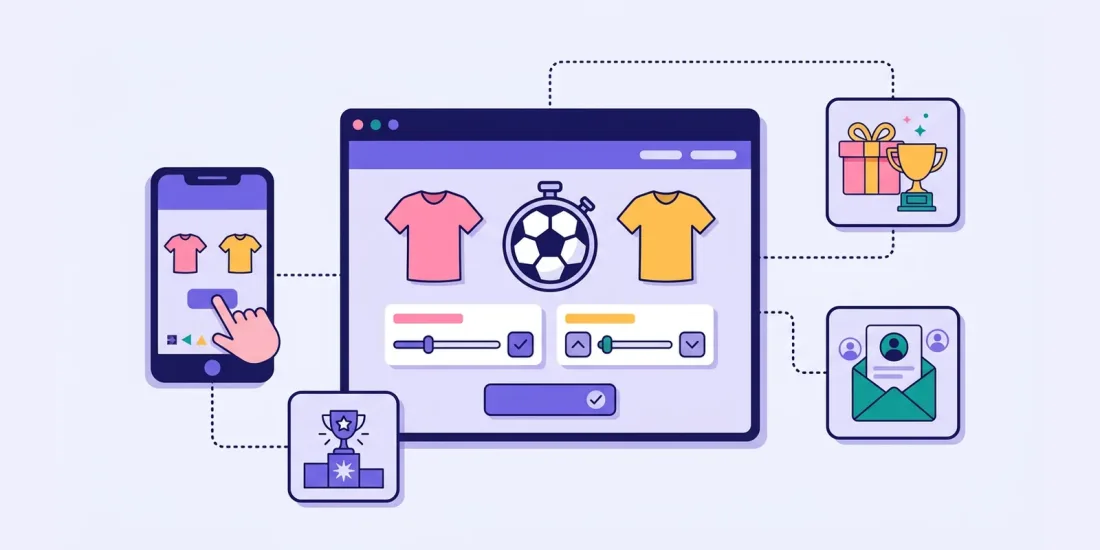
- You add the matches and the two sides in each one, for example two football or handball teams.
- People open the campaign, fill in a short sign-up form and enter their guess, such as 2-1.
- Predictions close at a deadline you set, for all matches at once or match by match, so nobody can guess after kick-off.
- After the deadline, people see a page you choose, for example "Thanks for playing, results on Monday".
- When the match is over, you reward the people who guessed right.
The big difference from a scratch card or a wheel is the waiting. A luck game is over in seconds. A prediction lives on until the final whistle. Fans think about their guess during the match, talk about it with friends and check back afterwards. That gives your brand a place in the whole experience, not just one click.
Sponsors, clubs and non-sports brands
Clubs
For a club, a prediction game is a way to get to know the fans. Many people come to a match, watch at home or follow online without the club ever knowing who they are. A short form before the guess changes that. Every player becomes a fan you can reach again with ticket offers, merch drops and news.
Sponsors
A logo on the boards is hard to measure. A sponsor-branded prediction game gives partners attention, sign-ups and numbers they can see. The sponsor can provide the prize, and the game can carry its colours and logo.
Aalborg Håndbold, which plays in the top Danish handball league, uses Scratcher campaigns to give its gold and main partners more value. At the start of each season, the club's activation team plans campaigns with these sponsors. One sponsor campaign with a kitchen company brought in around 2,000 participants and helped grow the club's newsletter. As Chris Thiessen from the club puts it: "Data is crucial because it allows sports clubs to demonstrate the value they can offer to sponsors." Read the Aalborg Håndbold story.
If sponsors are involved, be clear in the form about who will contact the fans and why, and ask for separate permissions if both the club and the sponsor want to send marketing.
Non-sports brands
You do not need to be a club to run a sports prediction competition. Big tournaments are moments the whole country talks about.
- Sports brands can tie the game to a new shirt or boot.
- Sports bars can give a free round to everyone who guesses right.
- Food and drink brands can link it to "match night" products.
- Retailers can run it around TV and electronics sales before a tournament.
- Media can use it to grow newsletters around their coverage.
Hummel, for example, used the guess the result format to let football fans predict the score of a match.
Single match vs tournament-long leaderboards
Single match
A single-match game is quick to set up and easy to explain: "Guess the score of Sunday's derby and win signed shirts." It works well for:
- Derbies, cup finals and season openers
- A sponsor's "match of the month"
- One-off events like a charity match
Launch it a few days before, remind people on the day, and close it at kick-off.
A whole tournament or season
For a tournament or a full season, add a leaderboard. Players then collect points across matches. By default, they get 3 points for the right result and 1 point for the right winner or a draw. The leaderboard shows who is on top, and you reward the best guessers when it ends.
This turns one visit into many. Fans come back for every match day to make new predictions and see how they rank. Some ideas:
- Group stage challenge: predict every match in a group, with prizes for the most points.
- Weekly round: a new set of matches every week through the season.
- Final four: predict the semi-finals and the final, with tickets for the top guessers.
- Office or club battle: invite colleagues or fan clubs to compete against each other.
The leaderboard is a special format, included on Professional or available as an add-on.
Prizes and repeat visits
Prizes fans love
Fans often value things money cannot easily buy:
- Signed shirts and balls
- Match tickets and season passes
- Meet-and-greets with players
- A sponsor's product, presented by the club
- Merch discount codes for everyone who takes part
You can reward everyone who guessed right, or draw winners among them. For a season-long game, consider a small prize for each round's winner and one big prize for the overall winner. See how prizes and draws work in Scratcher.
Bring people back
A prediction game has a built-in reason to come back: the result. Use it.
- After the match, send a short email or SMS with the right answer, the winners and a link to the next prediction.
- On match day, show a QR code on the big screen or on posters so fans in the arena can play on their phone in seconds. Aalborg Håndbold used the arena screens for a matchday quiz during Easter: about 1,000 of the 5,000 fans in the arena took part, a 28% conversion rate from interested fans to participants.
- Online, share the game in your newsletter, on social media and as a pop-up on your website in the days before.
- Between matches, keep the leaderboard alive by sharing the current top fans.
Data you can collect
A prediction game is a natural way to grow your list, because people need to leave their details to be contacted if they win. Keep the form short and ask only for what you will use. Typical fields:
- Name and email, so you can contact winners.
- Newsletter permission, written in your own words, plus a separate sponsor permission if needed.
- Phone number, if you plan to send the result by SMS.
- One or two extra questions, such as favourite player, season ticket holder (yes/no) or which city they follow the team from.
The guess itself is also data. Over a season, you can see who plays every week and who only joins for the big games. That helps you sort your most loyal fans from occasional ones.
Sign-ups can go straight to your email tool or CRM through Scratcher's integrations, Zapier, webhooks or the API, and you can follow visits and players per channel in near real time.
Examples: handball and football
Handball matchday. A club sets up a prediction for Saturday's home game, sponsored by a local business. A QR code is on the big screen during warm-up and on the posters at the entrance. Predictions close at throw-off. On Monday, everyone gets an email with the result, the winner and a link to next week's game.
Football tournament. A sports retailer runs a guess the score game for every match in a tournament's group stage. Fans sign up once and predict each round. The leaderboard gives points for correct results and correct winners, and the top fans win a new shirt. Everyone who signed up gets a discount code for the shop.
Derby day. A sports bar runs a one-match prediction for the biggest game of the season. Everyone who guesses right gets a free drink, and the bar collects emails for its event newsletter.
For more ideas across the season, read our guide to key moments to launch campaigns in sports, or see everything we offer for clubs and sponsors.
Quick checklist
- Matches and teams added, with a clear deadline at kick-off
- Prize shown on the start page, with clear terms
- Short form with your own consent text
- Leaderboard turned on if it runs over several matches
- QR code ready for the arena, posters or the TV broadcast
- Follow-up email or SMS planned for after the match
Start your prediction game
The next big match is already in the calendar, and your fans already have an opinion about it. Start a free 14-day trial and set up your first guess the result game, or book a meeting and we will help you plan a full season with your sponsors.