


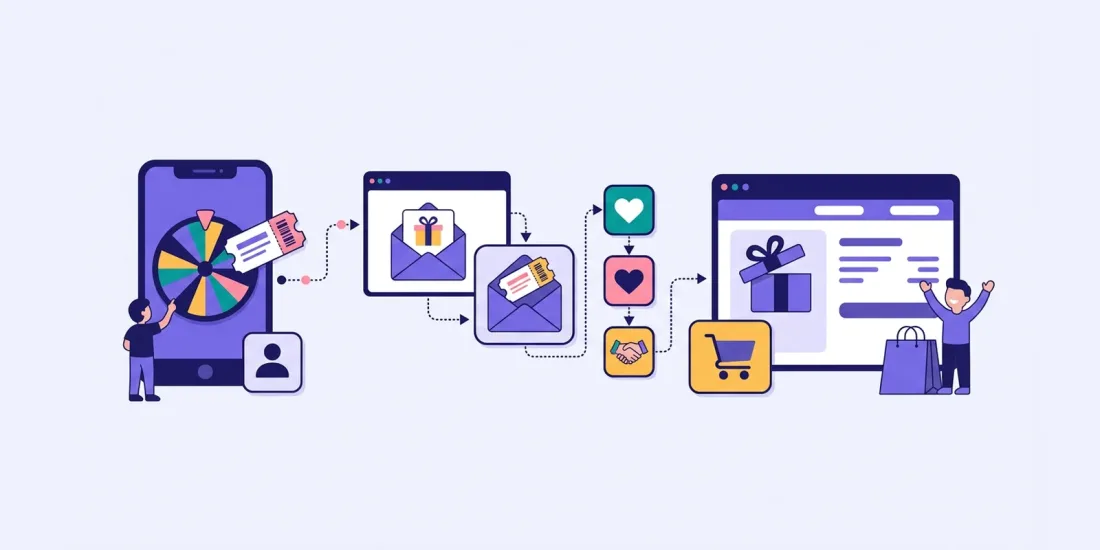
Someone has just spun your wheel, left their email and said yes to your newsletter. What happens next decides whether they become a customer or an unopened name on a list. A good welcome email flow turns the energy of the game into a first purchase. This guide shows you how to build a welcome series for people who signed up through a gamified campaign, with an example flow you can copy into Klaviyo, Mailchimp or HubSpot.
Why the first 72 hours matter
A new subscriber from a game is at their warmest right after they play. They know your brand, they may have just won something, and they are expecting to hear from you.
Wait a week, and the moment is gone. They may not remember signing up, and an email from a brand they do not recognise is easy to delete or mark as spam.
That is why the first few days should do three jobs:
- Deliver what you promised: the prize, the code or the result.
- Introduce your brand: who you are and why your emails are worth opening.
- Give a reason to buy now: while the reward is fresh and still valid.
Our article From lead to customer covers the strategy behind this. Here we focus on the hands-on flow.
Delivering the prize or code
The first email is the most important one. It should arrive within minutes.
- Put the prize in the subject line: "Your 15% code is inside" or "You won! Here's your gift card".
- Make the code easy to copy and show when it expires.
- Link straight to the shop, ideally with the code already applied if your shop supports it.
- Explain how to redeem it in store, if that is an option. A barcode on the phone is easier than typing a code at the till.
You can send this email from Scratcher or from your own email tool. With the Email module (included on Professional, or as an add-on), Scratcher sends prize emails with unique discount codes or barcodes automatically. Read more about prize handling.
If you would rather send everything from your email tool, use our integrations to send the sign-up, together with the fields you map, such as the prize won, the coupon code and any quiz answers. Then you can build the email in your own template.
Using game answers to personalise emails 2 and 3
Games are not just a way to collect emails. A quiz, a personality test or a product finder tells you what each person is interested in, and you can use that straight away.
- Quiz result: if someone's result was "the outdoor type", show outdoor products in email 2.
- Product finder: send the recommended product again, with reviews and a reason to buy.
- Poll or vote: if they voted for a flavour, tell them when it is back in stock.
- Prize choice: if people picked a prize category, that is a strong signal of interest.
BON'A PARTE did this with an outfit game: people picked their favourite top, bottoms and shoes after signing up for the newsletter. Everyone who did not win received a voucher and a round-up of the products they had picked, and those emails had a significantly higher open and contact rate than the brand's regular emails.
Toyota Denmark takes the same idea further. It uses quiz and survey answers to send personalised, behaviour-based emails, and around 35% of all Toyota sales in Denmark can be directly email-matched to the consented database built this way.
Non-winners: the consolation offer
In most campaigns, most people do not win the main prize. How you treat them matters, because they are the majority of your new list.
- Give everyone something small: free shipping, a small discount or a gift with the next order.
- Thank them for playing and tell them about the next chance to win, if there is one.
- Do not make them feel like losers. "You didn't win this time" can still lead to "but here's something for you".
Consolation prizes can drive real sales. Lampeguru gave a discount code to every participant who did not win one of its Black Friday gift cards, and the campaign contributed to six-digit revenue growth from both grand prizes and consolation codes. With the Email module, Scratcher can also send a separate email to people who did not win.
An example welcome email flow (5 emails)
Here is a simple flow you can adapt. The timings are a starting point, not a rule.
Email 1: Your prize (immediately)
- Subject: "Here's your prize from [brand]"
- The prize or consolation code, expiry date and a button to the shop.
- One sentence about who you are.
Email 2: Picked for you (day 1)
- Products or content based on their game answers or result.
- If you have no answers, use your bestsellers.
Email 3: Why people love us (day 3)
- Reviews, your story, what makes your brand different.
- A soft reminder of the code.
Email 4: Your code is about to expire (a day or two before expiry)
- Short and direct. One product, one button.
- This email often does a lot of the selling, so do not skip it.
Email 5: What to expect (day 7 to 10)
- What your newsletter brings, how often you send, and how to update preferences.
- An invitation to follow you on social media or join your loyalty club.
Branch for buyers: as soon as someone buys, move them out of the flow and into your post-purchase flow. Nobody wants a "your code is expiring" email after they have already used it.
Setting it up in Klaviyo, Mailchimp or HubSpot
The setup is similar in most email tools.
- Connect Scratcher to your tool. Choose the integration, log in and pick which fields to send. New sign-ups then arrive with every participation.
- Add a list, tag or property for the campaign, so you can trigger the flow only for people from this game.
- Create a flow triggered by that list, tag or property. In Klaviyo and Mailchimp this is usually an automation started when someone joins a list or gets a tag; in HubSpot, a workflow based on a contact property or list membership.
- Use conditional splits on game answers or prize to personalise emails 2 and 3.
- Add an exit condition for people who place an order.
- Check for double sends. If Scratcher sends the prize email, do not send it again from your email tool, and vice versa.
- Test with your own email address before launch: play, win, lose and check every email.
If you use double opt-in, the flow should start when the subscriber confirms, not when they sign up.
Metrics to watch
Track the flow as a whole, not just single emails.
- Code redemption rate: how many winners and non-winners used their code.
- First purchase rate: how many new subscribers bought within 30 days.
- Revenue per subscriber from the flow.
- Open and click rates for each email, to spot weak links.
- Unsubscribe rate in the first two weeks. A high rate can mean the wrong prize or the wrong promise.
- Long-term activity: how many are still subscribed and active after three or six months.
Rascals Brewing saw the effect in its regular newsletter: 33% of the orders from one newsletter came from people who had signed up through the Scratcher campaign.
Turn your next game into a welcome flow
A game gets people to say yes. The welcome flow turns that yes into a customer. Plan both at the same time: choose prizes you can deliver by email, ask a question or two you can use for personalisation, and have the flow ready before you launch.
Try Scratcher free for 14 days and connect your email tool in a few clicks, or book a meeting and we will help you plan the campaign and the flow that follows it.