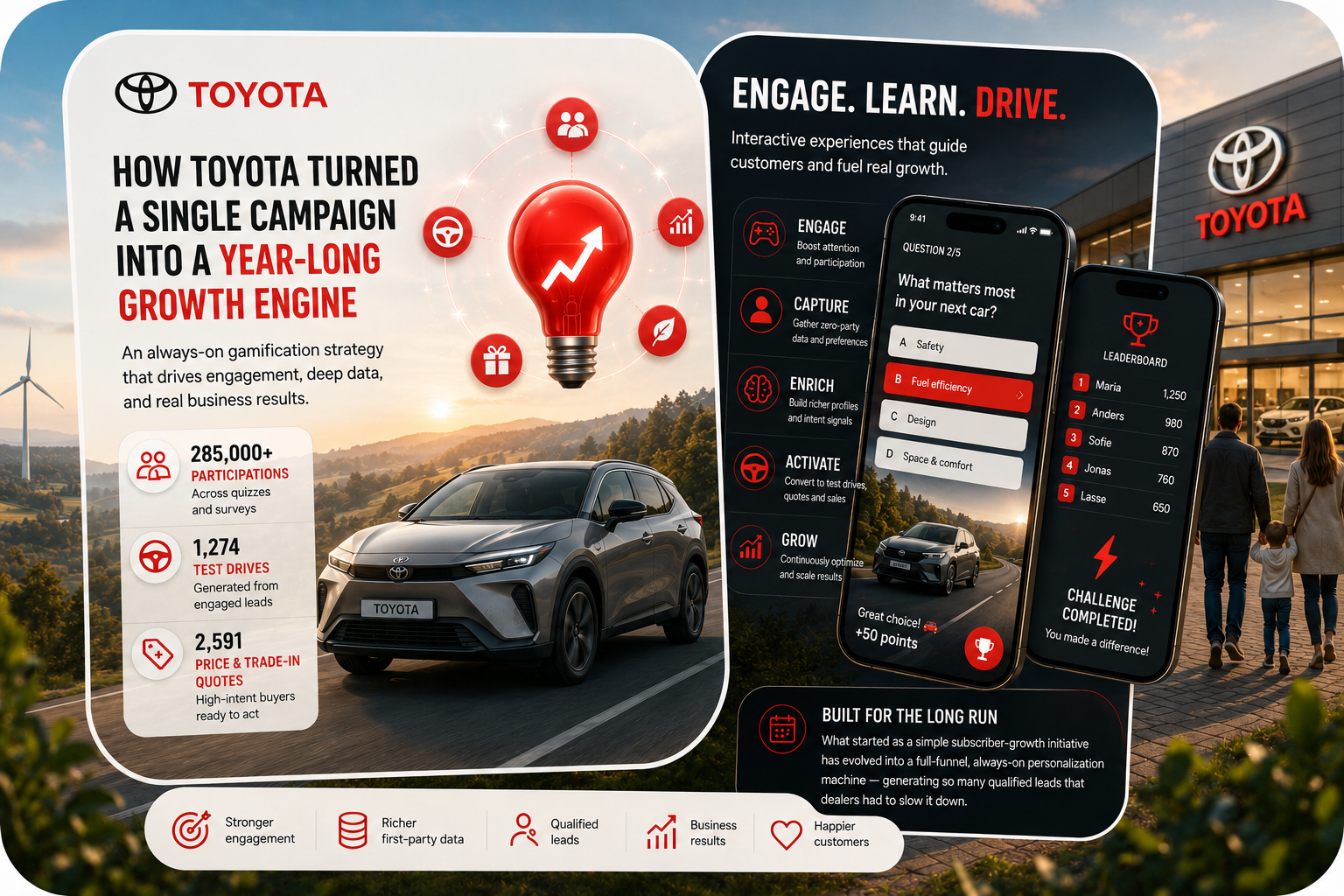
285,000+ participation across quizzes and surveys, driving deep data enrichment, 1,274 test drives, and 2,591 price and trade-in quote requests
In an era where automotive brands are fighting declining attention, fragmented journeys, and tightening privacy regulation, Toyota Denmark has quietly built one of the most effective first-party data engines in European automotive marketing. The engine’s backbone? A long-running collaboration with Scratcher, designed not as a short-term sales stunt, but as a durable, consent-driven growth system.
This case was developed in close collaboration with Martin Madsen-Mygdal, Senior Marketing Automation Consultant and Partner at POPULATE, and the Toyota Marketing Team, combining strategic automation, data architecture, and commercial activation into one integrated growth model.
What began years ago as a simple subscriber-growth initiative has evolved into a full-funnel, always-on personalization machine—one capable of generating so many qualified leads that dealers were forced to slow it down.
The results: The campaign delivered strong engagement and measurable commercial outcomes. In total, the experience generated more than 285,000 cumulative quiz and survey interactions across five touchpoints (reflecting total participation, not unique individuals). Each interaction enabled significant data enrichment, as each step added deeper insight into customer interests, vehicle ownership, and buying intent.
Beyond engagement, the campaign generated clear lower-funnel impact, including more than 1,274 test drive actions and 2,591 price and trade-in quote requests, providing Toyota’s dealers with a steady flow of high-intent leads.
Combined, the scale of participation and the depth of zero- and first-party data collected allowed Toyota to personalize follow-up communication and convert engagement into qualified demand over time.
From permission to purchase: From “Win a Car” to ownable customer intelligence
At face value, the campaign looks familiar: quizzes, competitions, and the chance to win a brand-new Toyota—fully paid and tax included. But the real strength lies beneath the surface.
Participants don’t simply enter a draw. They engage in educational quizzes that explain electric vehicles, Toyota’s key USPs, and real ownership considerations. Every interaction is fully consent-based, and every answer becomes a meaningful signal. Over time, Toyota refined this setup into a sophisticated first-party data engine, combining declared intent, behavioral insights, and ownership context at scale. Today, this recurring annual campaign framework has helped Toyota build close to 175,000 opted-in subscribers in Denmark, forming the backbone of its personalized marketing efforts.
The campaign itself is structured around a clear three-step journey:
1- collecting permissions,
2- educating consumers while enriching data,
3- and converting interest into sales.
It starts with permission-based acquisition, generating 21,226 new email permissions and driving significant traffic to Toyota’s owned channels, with 141,823 visitors and 252,879 page views on toyota.dk.
From there, both newly acquired subscribers and existing Toyota subscribers moved into a gamified learning experience designed to educate and gather data. Across five competition modules, 22,352 participants completed the final survey, delivering rich zero-party data.
As Martin explains: “We look at what are their intentions, what is their behavior, what are they interested in, and then we send them personalized emails.”
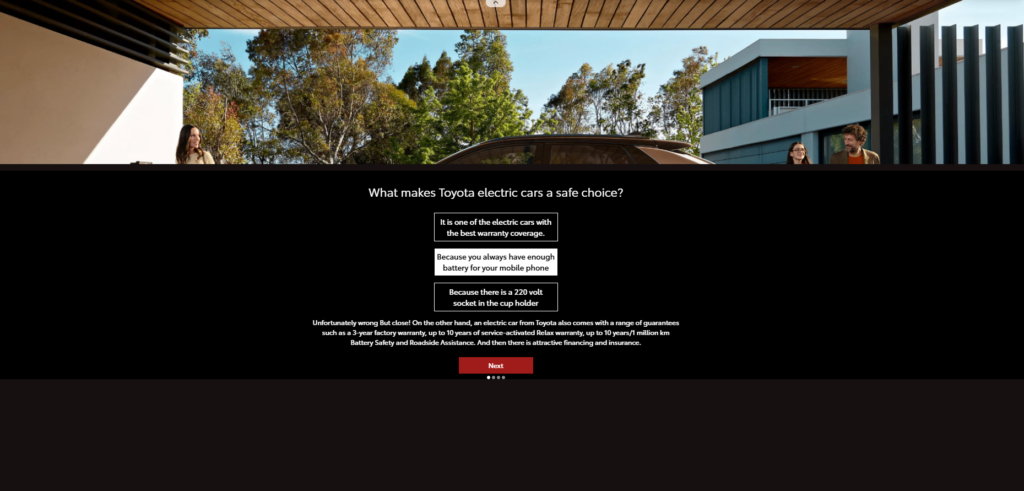
The collection of 19,439 valid license plates revealed that 50% of participants were not existing Toyota owners, demonstrating the campaign’s ability to attract entirely new potential buyers while repeatedly exposing them to messaging around the Yaris and Toyota Hybrid models.
Finally, the campaign translated engagement into measurable commercial impact. Personalized, behavior-based email flows drove strong lower-funnel results, directly contributing to 768 campaign-attributed vehicle sales.
The Email traffic to toyota.dk alone generated 823 trade-in leads and 92 test drive bookings, while dealer-level activity added further conversions, including 63 preorders of the Yaris Premier Edition, 108 private showroom sessions, 440 completed test drives, and 1,021 unique offers.
While total Yaris sales exceeded 4,000 units within the first three months of launch, these figures represent sales that can be directly attributed to the campaign and its first-party data activation.
Email as the most defensible channel in the mix
In a media landscape facing constant budget pressure, this campaign has become untouchable.
Approximately 35% of all Toyota sales in Denmark can be directly email-matched to this consented database. The true influence is likely far higher, but Toyota has deliberately taken a conservative attribution stance, claiming contribution, not ownership, of the sale.
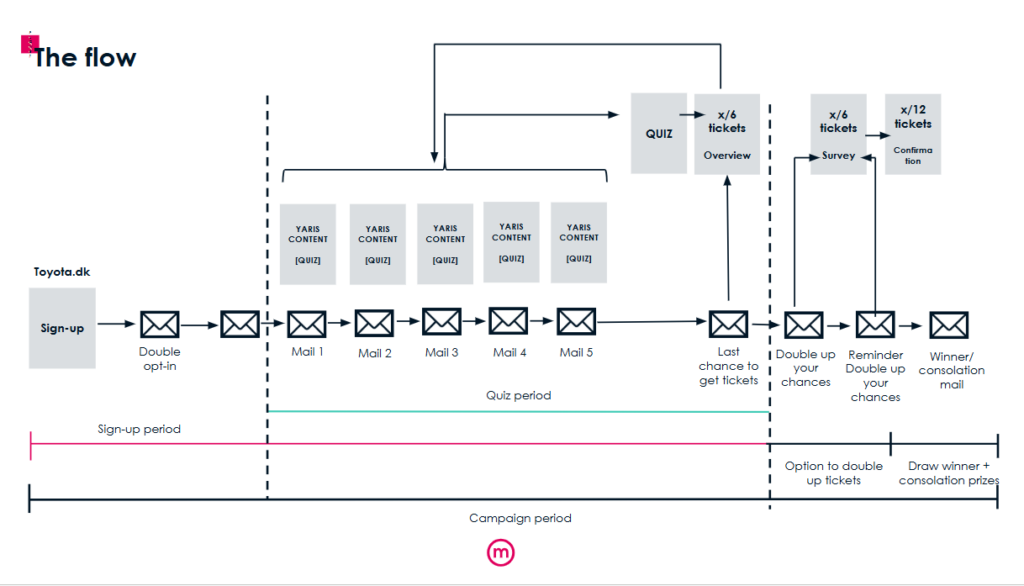
Every week a mail was sent with the following:
- Information about the new Yaris
- What weekly price could be won by participating in the weekly competition
- An overview of all the tickets collected/available to collect
While other channels face cuts, email and first-party activation remain protected. Why? Because the impact is measurable, attributable, and dealer-validated.
First-party data that actually converts
What sets this case apart is not the competition itself, but how the data is activated over time.
By combining quiz responses, survey insights, and self-reported vehicle data—such as ownership status, powertrain preference, leasing behavior, and car age—Toyota can:
- Identify customers who are not ready to convert today
- Understand their current situation and intent, including interest in hybrid, electric, or traditional powertrains
Predict when they are likely to become ready to buy or lease
- Trigger precisely timed, personalized outreach when conditions change
A customer locked into a long-term lease doesn’t receive generic sales messaging. Toyota knows when exit windows open and responds with tailored communication around options, incentives, and trade-in opportunities—exactly when it’s relevant.
It’s patience, powered by data.
When demand becomes the bottleneck
The campaign’s performance was so strong that success became operationally challenging.
In both 2024 and 2025, Toyota had to throttle lead delivery, releasing conversions in batches to avoid overwhelming dealerships during peak summer months. At full scale, the activity could generate up to 800 qualified customer leads per day, a rare problem in a market where most automakers are struggling to fill the top of the funnel.
As Martin notes:
“Having too many leads is a very unique situation to be in. Everyone else is screaming to get customers.”
Crucially, Toyota didn’t chase volume blindly. By adjusting messaging and mechanics, the brand intentionally traded quantity for quality, ensuring that competition-driven leads remained commercially relevant.
The result?
- Standard “get a quote” conversion rate: ~9%
- Competition-sourced conversion rate: ~7%
One campaign. Twelve months of impact.
Perhaps the most striking insight is structural.
Toyota doesn’t run dozens of disconnected lead-gen efforts. Instead, it builds one major annual campaign, then uses the resulting data to fuel personalized communication, product launches, and dealer traffic for the entire calendar year, until the cycle begins again.
In an industry known for complexity and constant campaign churn, this focus is radical.
And it works.