


This case shows how Andel Energy uses interactive campaigns and gamification marketing to generate high-quality leads, collect zero-party data, and increase customer engagement. By turning passive traffic into active participation, they improved both conversion rates and lead quality.
About Andel Energi
Andel Energi is Denmark’s largest energy company, providing electricity, gas, and energy consulting to more than 1.2 million private and business customers. As part of the Andel Group, the company plays a key role in supporting the green transition by making climate-smart energy solutions more accessible through products such as heat pumps, solar panels, EV charging, and digital tools that help customers track consumption and make greener choices.
The challenge: turning traffic into real customer relationships
For Andel Energy, the challenge was never traffic.
They already had that.
The real challenge was what came after, turning attention into usable customer relationships.
Not just clicks, but real, qualified data that sales teams could actually work with.
To understand how this works in practice, we spoke with the team behind the campaigns. Anne Bunch-Poulsen, Marketing Consultant, focuses on campaign strategy and lead generation. Julie Liljegren, Web Editor, builds and optimises the interactive campaign experiences. Astrid Beyer Lauring, Marketing Automation Consultant, ensures the data collected is activated across CRM and customer journeys.
Together, they cover the full lifecycle—from strategy to execution to activation.
A high-friction reality
Because at Andel Energy, collecting data isn’t simple.
When a user enters a campaign, they don’t just ask for a name or an email. They need everything—phone number, address, permissions—all in one go.
No progressive profiling. No second chances. Just one moment. One decision.
“We have to get all the information at once… so you really have to incentivise well,” explains Anne.
That creates a level of friction most companies never have to deal with.
And for a long time, it showed. Campaigns would drive traffic, but when users hit the form, many dropped off. The interest was there—but not the motivation to go all the way.
And even when leads came in, another problem appeared. They weren’t always usable.
“We want proper warm leads… otherwise we spend a lot of effort on very cold leads,” says Astrid.
Rethinking the problem
So the challenge wasn’t just conversion. It was conversion quality.
At some point, the team stopped looking at the form as the problem—and started looking at everything before it.
What if users weren’t dropping off because of the data request…but because they didn’t feel engaged enough to justify it? That shift led to a simple but powerful realisation:
“When we made it more engaging and fun, we got more people to willingly share their information,” Anne explains.
Instead of pushing harder for conversion, they started focusing on earning the interaction first. And from there, everything changed. This wasn’t treated as a one-off experiment.
Building a dedicated setup
The team built a dedicated setup around it—a way of working where campaigns are designed not just to attract attention, but to create interaction.
“We created our own gamification marketing team… responsible for lead generation and customer engagement,” Anne says.
Their role wasn’t just to launch campaigns. It was to design experiences that could:
- Attract new users
- Capture high-quality data
- Qualify leads before sales
- Re-engage existing customers
“We don’t just focus on permissions, but what we want to do with them afterwards,” she adds.
Before scaling this approach, they had already experimented with gamification—but the setup didn’t work.
“We had very complex solutions that were not scalable… we couldn’t adjust anything,” Julie explains.
To make this work long-term, they needed something simpler, faster, and fully in their control. That’s where Scratcher came in. Ease of use was critical—but so was speed.
“It’s easy to use, quick to launch, and doesn’t require a lot of development. It made it simple for us to test new ideas fast,” Julie says.
Just as important was the experience on the user side. Campaigns needed to feel engaging—not just functional—and contribute to how people perceive the Andel Energy brand. At the same time, the team needed a platform that worked well on all devices.
“The majority of users interact with our campaigns on mobile, so being able to quickly create and adjust mobile-friendly experiences is essential,” Julie adds.
But beyond the platform itself, one factor stood out: the collaboration.
“It’s very important for us to have a dialogue-based and professional relationship, and to work with someone who understands our ways of working. Having a consistent point of contact made it easier to brief campaigns, solve issues quickly, and move faster as a team.” — Anne Bunch-Poulsen, Marketing Consultant at Andel Energy
Easter campaign activation
A recent example of this approach is their Easter campaign, “Påskejagt i Energihaven.”
Instead of a traditional campaign, the team created a playful, interactive “hide-and-seek” experience. Users explored a visual environment filled with hidden Easter eggs—each one unlocking a separate game through a mystery box.
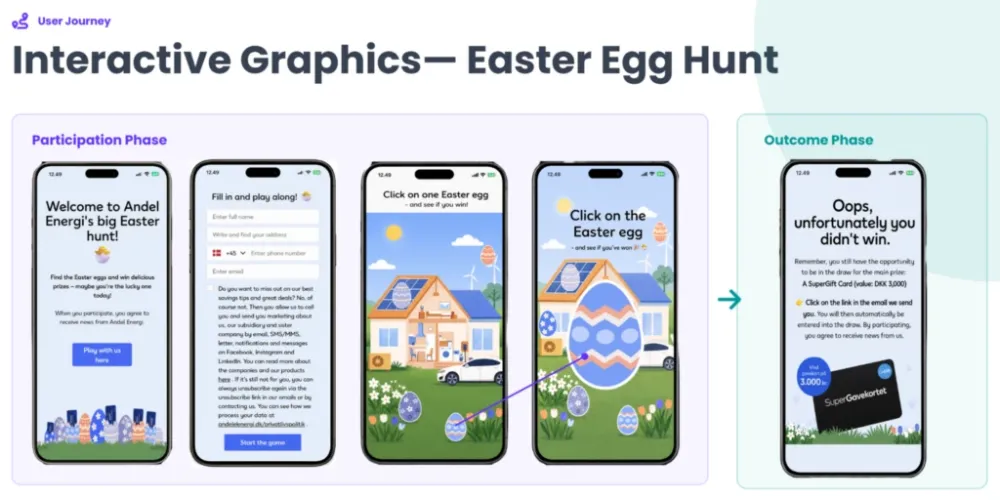
The goal was simple: generate leads and collect marketing permissions.
But the way to get there was entirely different. Traffic came from across their full ecosystem—paid media, email, website placements, app, and customer touchpoints—bringing users into a campaign that felt more like an experience than a form.
Results
- 2,467 total engagement hours, equivalent to 100+ full days of attention spent with the brand
- 55,000 campaign participants, nearly 50% of them new users
- 37% funnel conversion rate, from campaign entry to submitted contact information
The real KPI: depth, not just reach
What stands out most is not just how many people the campaign reached—but how long they stayed.
Participants spent an average of 1 minute and 26 seconds actively engaging with the experience, resulting in a total of ~2,467 hours of interaction time.
That’s the equivalent of more than 100 full days of attention spent with the Andel Energy brand. At a time when most campaigns fight for seconds, this level of sustained attention is something traditional advertising simply cannot buy.
Results under real constraints
What makes Andel Energy’s results stand out is not just the numbers—it’s the context behind them.
They now see 82% of users confirming their contact information after sign-up—far above typical benchmarks.
“82% are confirming their contact information… we’re very proud of that,” Anne says.
Campaigns are also reaching scale, with over 55,000 participants in a single activation, nearly half of them new participants.
At the same time, they are seeing conversion rates around 37% through the funnel—impressive given the amount of data required.
Beyond acquisition
But the real impact goes beyond acquisition. Interactive campaigns are activating customers who previously didn’t engage—supporting retention and anti-churn efforts.
“We managed to activate customers we haven’t been able to activate before,” Astrid says.
Customer surveys, for example, saw a 3x increase in participation when tied into more engaging experiences.
“Participants in our survey increased three times compared to the previous month,” she adds.
The shift that changed everything
What becomes clear over time is that the biggest shift wasn’t tactical—it was behavioural.
“As soon as we get users to an interactive campaign experience—even small things—it performs better than hard conversion campaigns,” Anne explains.
Instead of forcing the sale, the team creates a moment. That’s ultimately what changed. Not the form. Not the process. But the experience around it.