


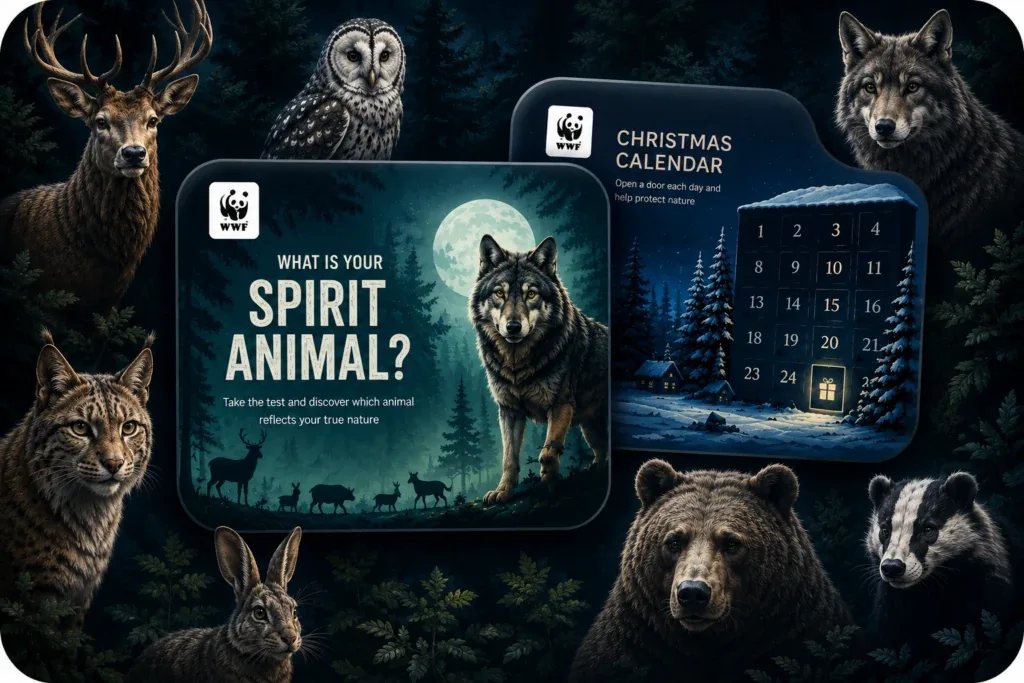
How WWF Denmark uses interactive experiences to educate audiences, generate qualified leads, and build long-term donor relationships.
About WWF Denmark
WWF is the world's leading independent conservation organisation, working to protect nature and create a future where people and wildlife can thrive together. With projects spanning more than 100 countries, WWF continues to inspire millions of people to take action for a healthier planet and a more sustainable future.
Most fundraising teams spend a lot of time thinking about donations.
WWF Denmark spends a lot of time thinking about what happens before the donation.
That distinction may sound small, but it has fundamentally shaped how the organisation approaches digital engagement, audience growth, and fundraising today.
For more than five years, WWF Denmark has been using interactive experiences as part of its digital fundraising strategy. During that time, the organisation has tested everything from educational quizzes and Christmas calendars to personality-based campaigns, lead generation flows, and donation journeys.
What they discovered challenges one of the most common assumptions in fundraising:
The shortest path to a donation is not always the most effective one.
The Real Challenge Isn't Fundraising
When speaking with Birgit Winkel, Head of Private Fundraising & Digital at WWF Denmark, she immediately reframes what many marketers assume is the problem. "The competition among NGOs is really intense these days," she explains. "People are a bit anxious to use money at all, especially when it comes to NGOs, but they still like to engage."
That observation has become increasingly important.
Across industries, organisations are facing the same challenge. Audiences are overwhelmed by content, advertisements, and competing messages. Trust takes longer to build, attention is harder to earn, and people rarely make decisions after a single interaction.
For WWF, this means that fundraising is no longer simply about asking for support. It's about creating enough interest, understanding, and engagement before asking people to commit.
As Birgit puts it: "There is a longer way from first contact to donation than there has ever been before." That realisation would eventually change how WWF approached its entire donor journey.
Moving From Donation-First to Relationship-First
When WWF first began experimenting with interactive experiences, the objective was relatively straightforward: create campaigns that could drive people directly towards donations.
Like many organisations, the team initially hoped to create shorter and more efficient conversion paths.
Over time, however, the data told a different story.
"In the beginning, we were trying to get directly to donations, a quick and short donor journey," says Birgit. "What we have learned during the years is that the donor journey is longer."
Instead of treating campaigns as conversion tools, WWF began treating them as relationship-building tools.
Today, the organisation uses interactive experiences primarily to engage audiences, educate supporters, collect leads, and continue the conversation through marketing automation.
"What we're especially using Scratcher for now is collecting leads, generating leads," Birgit explains. "We take the leads into our Agillic marketing automation database and then we're working with them afterwards."
That shift—from immediate conversion to long-term relationship building—has become one of the most important lessons in WWF's digital fundraising strategy.
Why Education Became the Strategy
Unlike many brands that use gamification purely for entertainment, WWF approaches interactive experiences through a different lens.
The goal isn't simply engagement. The goal is education.
"We are a knowledge-based organisation," says Birgit. "Usually it's something that builds up the audience's knowledge about nature or special species or whatever it is."
This philosophy explains why quizzes have become one of WWF's most successful formats.
Rather than presenting supporters with a static form or a donation request, quizzes create an opportunity to learn, participate, and engage with WWF's mission in a meaningful way.
Participants discover something new about wildlife, biodiversity, climate issues, or conservation efforts while WWF gains an opportunity to start building a relationship. "It's a more entertaining way of education," Birgit explains.
For WWF, engagement is not the destination. It's the doorway.
Building a Scalable Lead Generation Engine
Today, interactive campaigns play a central role in WWF Denmark's lead generation strategy.
The organisation primarily collects simple information such as names, email addresses, and occasionally phone numbers. The objective is to reduce friction while creating opportunities for future engagement.
Behind the scenes, every lead is automatically transferred into WWF's Agillic marketing automation platform.
According to Paw, responsible for Website Data Tracking and User Experience at WWF Denmark, this integration has been essential. "The integrations to our email platform make it much easier for us to use Scratcher because we can collect the leads simply."
The automation eliminates manual exports, spreadsheet management, and repetitive administration work, allowing the team to focus on communication rather than data handling.
"We can work trigger-based in our email platform," Paw explains. "The Scratcher system and the integration to all the systems behind it are working very well."
The result is a smoother transition from engagement to nurturing, allowing WWF to continue conversations long after the initial interaction.
The Campaign That Looked Average—Until It Didn't
One of the most valuable lessons came from a campaign focused on Danish nature.
Initially, the results seemed relatively ordinary. Nothing stood out. The team wasn't particularly impressed.
But months later, after digging deeper into the data, the picture changed.
"When we actually looked into the data and analysed it more, it looked like it had been quite effective," says Birgit.
The campaign introduced a more advanced journey that allowed participants to choose different paths based on their interests and intentions. Rather than pushing everyone through the same experience, the campaign created multiple routes and engagement points.
What initially looked like an average campaign turned out to be generating stronger long-term engagement than expected.
"There is something about really engaging people in the long run," Birgit reflects.
It's a reminder that not every successful campaign reveals its value immediately. Sometimes the most important results happen after the click.
The Spirit Animal Campaign Nobody Expected to Work
If the Danish Nature campaign reinforced WWF's belief in long-term engagement, another campaign challenged their assumptions entirely.
The campaign was called Spirit Animal.
Participants answered a series of simple questions and were matched with an animal personality such as a fox, hedgehog, or other wildlife-inspired character.
The concept was developed with support from interns and represented something very different from WWF's traditional communication style.
"That's really something WWF would never normally do," Birgit admits. Expectations were modest. Yet the campaign became one of the organisation's most successful lead generators.
Over a six-month period, the campaign generated:
- 33,502 impressions
- 12,400 interactions
- 10,557 participants
- 37.01% interaction conversion rate
- 31.51% participant conversion rate
- 2 minutes and 33 seconds average engagement time
- 450 hours and 38 minutes of total engagement time generated
The majority of traffic was driven through Facebook, which became the primary activation channel behind the campaign's success.
What makes these results particularly impressive isn't simply the reach, but the level of engagement generated. More than 10,500 people actively participated in the experience, generating over 450 hours of engagement around WWF's mission and wildlife conservation efforts.
The experience generated a significant number of leads and remained active for an extended period.
For the team, it was a valuable reminder that engagement often begins with curiosity, not conversion.
Why First-Party Data Matters More Than Ever
As digital advertising becomes increasingly complex, WWF has also had to adapt to changing platform rules and privacy regulations.
Meta's advertising restrictions have created additional challenges for many organisations, particularly those operating around advocacy, environmental issues, and fundraising.
"Meta has launched some new rules which make it difficult for us to do our advertising," Birgit explains.
Rather than becoming more dependent on paid media, WWF has focused on building direct relationships with audiences.
Interactive experiences have become an important part of that strategy because they create opportunities to collect first-party data while simultaneously educating and engaging supporters.
"It makes even more sense for us to use interactive experiences because that's a way to work around it," says Birgit. "Playing, quizzing, educating instead of being political."
For modern marketers, the lesson is clear: owned audiences are becoming increasingly valuable.
The Christmas campaign that became a tradition
While Spirit Animal helped WWF attract new audiences, the organisation's annual Christmas Calendar serves a different purpose.
Rather than focusing on acquisition, it focuses on retention, recurring engagement, and strengthening relationships with existing supporters.
The campaign has now been running successfully for three consecutive years and has become a recurring part of WWF Denmark's engagement strategy.
"The Christmas campaign is successful. It's really traditional, but it works really, really well."
The numbers explain why.
During the 2024 Christmas Calendar campaign, WWF generated 20,683 impressions, 17,707 interactions, and 12,403 participants, resulting in an impressive 85.61% interaction conversion rate and a 59.97% participant conversion rate.
Perhaps even more interesting was the role of owned channels.
WWF's newsletter generated more than 8,000 participants, accounting for nearly two-thirds of all campaign participation. Facebook contributed an additional 2,686 participants, while organic and direct traffic generated the remainder.
This demonstrates the power of combining interactive experiences with an engaged subscriber base.
Rather than relying exclusively on paid media, WWF used the Christmas Calendar to activate existing supporters, drive webshop engagement, and create daily interactions throughout December.
As Birgit explains: "The Christmas calendar makes a lot of sales in our webshop. It's not donations, but it's revenue."
More importantly, it keeps WWF relevant and present in supporters' lives for 24 consecutive days—a powerful foundation for future fundraising efforts.
“The integrations to our email platform make it much easier for us to use Scratcher because we can collect the leads simply. We can work trigger-based in our email platform. The Scratcher system and the integration to all the systems behind it are working very well.” — Paw Nielsen, Digital Specialist at WWF Verdensnaturfonden
The Real Bottleneck Isn't Technology
One of the most honest moments during the conversation came when discussing campaign production.
Many case studies suggest that technology is the primary challenge.
For WWF, that's not the reality. "The system and integrations are working very well," says Paw. The real challenge is creating the content. "Collecting the information, collecting the photos, making the material—that takes a long time."
It's a reality that many marketing teams will recognise. The limiting factor is rarely the platform. It's time, resources, approvals, and production capacity.
Like many organisations, the challenge is finding enough time and resources to execute every idea.
Measuring Success
Despite operating sophisticated donor journeys, WWF's success metrics remain surprisingly simple. The first KPI is cost per lead, the second one is what happens afterwards, the conversion rate of the leads to donors.
Lead volume alone isn't enough. The real question is whether those leads become long-term supporters.
According to WWF's experience, the answer is yes, "The leads we're getting are of good quality."
A Lesson Beyond Fundraising
Although WWF's mission is unique, the lessons from its experience apply far beyond the non-profit sector.
Whether you're selling products, memberships, subscriptions, services, or donations, the reality is increasingly the same.
People rarely convert after a single interaction. They engage first. They learn. They explore. They build trust. And only then do they commit.
For WWF Denmark, interactive experiences have become a way to facilitate that journey—not by replacing fundraising, but by creating the engagement that makes fundraising possible.
As Birgit summarises: "There is something about really engaging people in the long run."
In a world where attention is increasingly difficult to earn and trust is increasingly difficult to build, that may be one of the most important marketing lessons of all.
Results
- 12,403 participants in the 2024 Christmas Calendar
- 85.61% interaction conversion rate
- 59.97% participant conversion rate